OpenAI will retire ChatGPT Advanced and Standard voice on December 11 2026
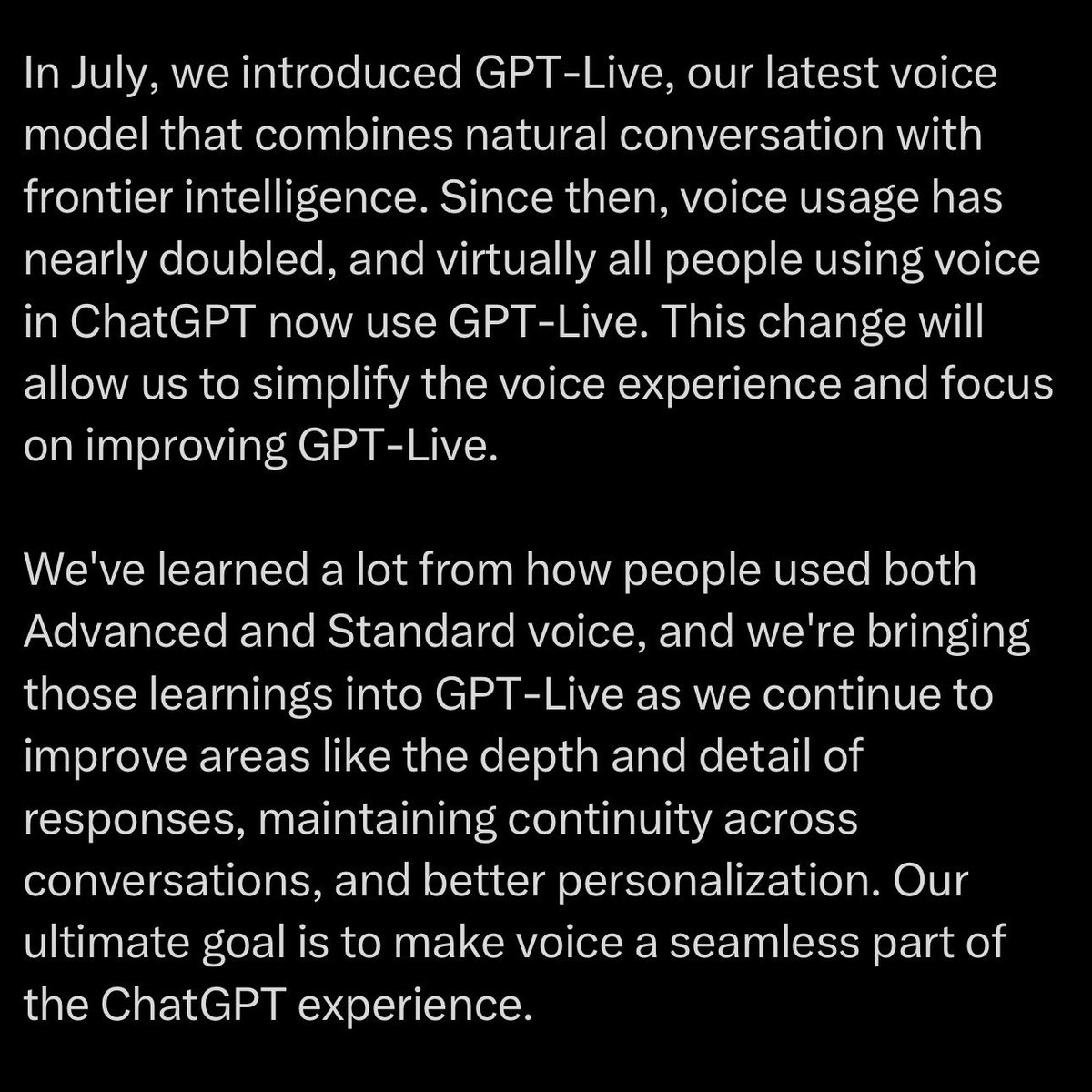
OpenAI’s official Newsroom account said ChatGPT Voice will drop its Advanced and Standard voice modes on December 11, 2026, framing the cutover around GPT-Live, the voice stack OpenAI rolled out in July to pair more natural dialogue with stronger model capability. The announcement situates the retirement as consolidation behind a newer default rather than an abandonment of voice: accompanying language in the linked post notes that voice usage has nearly doubled since GPT-Live arrived, though the packet does not spell out migration steps, replacement labels, or regional timing. For anyone shipping voice assistants or auditing model dependencies, the fixed sunset date is the operative planning anchor, while product details beyond the Newsroom wording remain thin until OpenAI publishes fuller guidance.
OpenAI will retire ChatGPT Advanced and Standard voice on December 11 2026
OpenAI’s Newsroom announced that Advanced and Standard voice modes in ChatGPT Voice will be retired on December 11, 2026. The post ties the move to GPT-Live, the voice model OpenAI introduced in July to combine natural conversation with frontier intelligence.
Key takeaway
Treat December 11, 2026 as the hard sunset for ChatGPT Voice Advanced and Standard, and replan any user flows or docs that still name those modes.
What happened
OpenAI’s Newsroom posted on X that Advanced and Standard voice modes within ChatGPT Voice will be retired on December 11, 2026, according to the owned-news summary in the evidence packet.
The same announcement ties the change to GPT-Live, described as the voice model OpenAI introduced in July to combine natural conversation with frontier intelligence; the linked post also states that voice usage has nearly doubled since that introduction.
Evidence
OpenAI will retire Advanced and Standard voice modes in ChatGPT Voice on December 11, 2026.
X · attributed
We’re retiring Advanced and Standard voice from ChatGPT Voice on December 11, 2026.
The retirement is linked to GPT-Live, OpenAI’s July voice model pairing natural conversation with frontier intelligence.
X · attributed
In July, we introduced GPT-Live, our latest voice model that combines natural conversation with frontier intelligence.
Voice usage has grown sharply since GPT-Live launched.
X · attributed
Since then, voice usage has nearly doubled, and virtually all people using
Why it matters
A named deprecation window forces product and compliance teams to verify which voice stack users actually hit after the cutoff, because the packet only names modes being removed, not a full replacement map.
Limits and uncertainties
The packet truncates the Newsroom post before it finishes describing who uses voice or what replaces Advanced and Standard.
No migration checklist, API surface, or enterprise comms appears in the evidence beyond the December 11, 2026 date and GPT-Live reference.
Secondary social commentary in the packet is not attributed to OpenAI and must not be read as official product roadmaps.
Practical implications
Inventory in-app copy, support macros, and analytics labels that reference Advanced or Standard voice before the December 11, 2026 cutoff.
Re-test voice UX against whatever default ChatGPT Voice exposes after retirement, since the packet does not document parity with the retired modes.
What to watch
Further OpenAI Newsroom or product posts clarifying which voice option remains and how existing users are moved off Advanced and Standard.
Any pre-December 11, 2026 changes to GPT-Live or ChatGPT Voice defaults that would affect realtime voice integrations.
Original reporting: We’re retiring Advanced and Standard voice from ChatGPT Voice on December 11, 2026.
In July, we introduced GPT-Live, our latest voice model that combines natural conversation with