Meta ships Muse Ember, positioning its smallest model for agent-scale token work
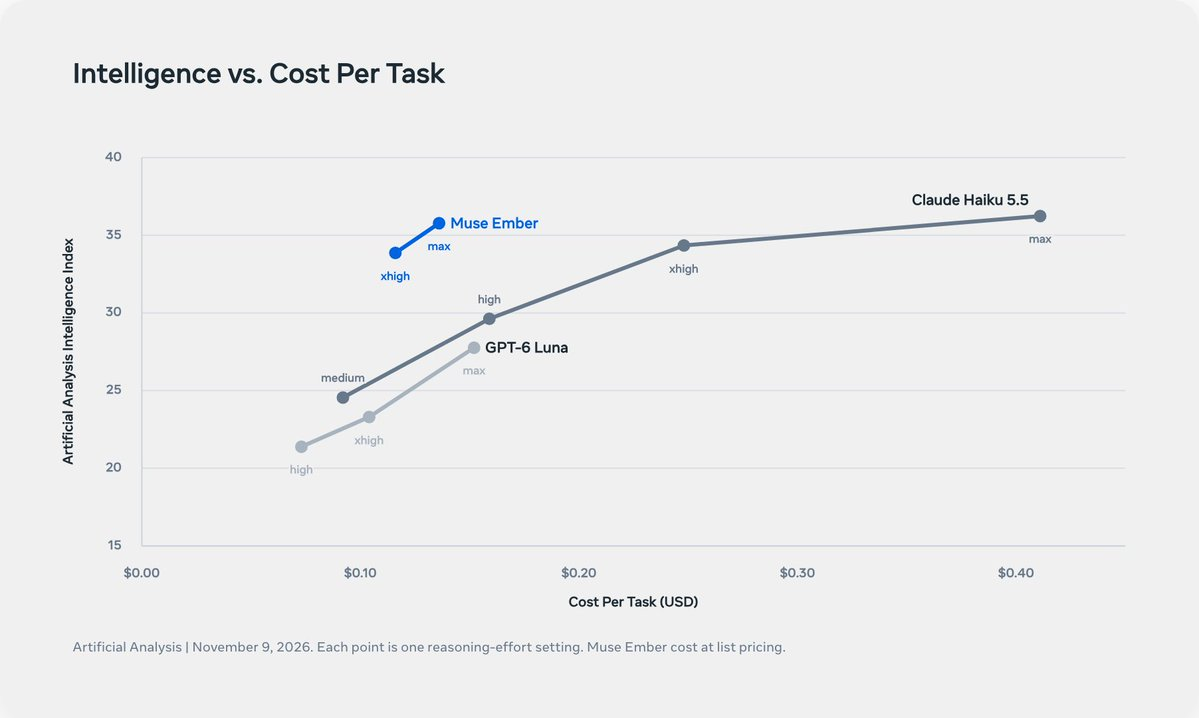
Meta has released Muse Ember, framed as the company's smallest model tuned for agent workflows that burn through tokens all day. The announcement emphasizes intelligence per dollar within its size class rather than raw frontier scale, and explicitly lists the workloads Meta wants to optimize: tool calls, coding subtasks, routing, extraction, and long document parsing. Availability is positioned as immediate on Meta's platforms, signaling a push to make cheap inference the default layer for repetitive agent steps. For builders running multi-step automations, the practical bet is that subtasks that once required larger models may shift downstack if quality holds. Independent benchmarks and full pricing were not detailed in the primary announcement, so production adoption still depends on hands-on evaluation against incumbent small models.
Meta ships Muse Ember, positioning its smallest model for agent-scale token work
Meta announced Muse Ember today as its smallest model aimed at higher intelligence per dollar in its class. The release targets token-heavy agent workloads including tool calls, coding subtasks, routing, extraction, and long document parsing.
Key takeaway
Muse Ember is Meta's bet that the smallest tier can carry most repetitive agent token work if cost-efficiency and routing tasks are the bottleneck.
What happened
Meta announced Muse Ember as its smallest model, aimed at delivering higher intelligence per dollar than others in its class, according to reporting tied to the release announcement on X.
The model is built for token-heavy agent work such as tool calls, coding subtasks, routing, extraction, and long document parsing, with messaging that it is available today on Meta distribution channels including the Meta Model API and Muse Code.
Evidence
Meta positioned Muse Ember as its smallest model for higher intelligence per dollar in its class.
X · attributed
Meta announced Muse Ember today as its smallest model aimed at higher intelligence per dollar in its class.
The release targets repetitive token-heavy agent workloads.
X · attributed
Built for token-heavy work that agents repeat all day: tool calls, coding subtasks, routing, extraction, and long document parsing.
Muse Ember is described as available on Meta's model and coding surfaces.
X · attributed
A new Muse Ember model from Meta is now available on the Meta Model API and Muse Code.
Why it matters
If a credible small Meta model holds on agent subtasks, operators can reprice multi-agent pipelines around cheaper per-step inference instead of defaulting to mid-size models for every hop.
Limits and uncertainties
The packet contains no related articles and no independent benchmark data beyond social commentary in the evidence corpus.
Claims that Muse Ember performs on par with Claude 5.5 Haiku appear in the corpus but are not established in the primary owned-news body alone.
Practical implications
Teams running agent loops should pilot Muse Ember on high-frequency steps such as routing, extraction, and tool-call formatting before promoting it to orchestration-critical paths.
Cost models for agent products should be rechecked assuming a new Meta small-model tier is live on the Meta Model API and Muse Code.
What to watch
Whether Meta publishes benchmarks, pricing, and context-window specs that substantiate the intelligence-per-dollar positioning.
Early operator reports on tool-call reliability and long-document parsing quality versus incumbent small models.
Original reporting: Releasing Muse Ember today -- our smallest model that delivers higher intelligence per dollar than others in its class. Built for token-heavy work that agents repeat all day: tool