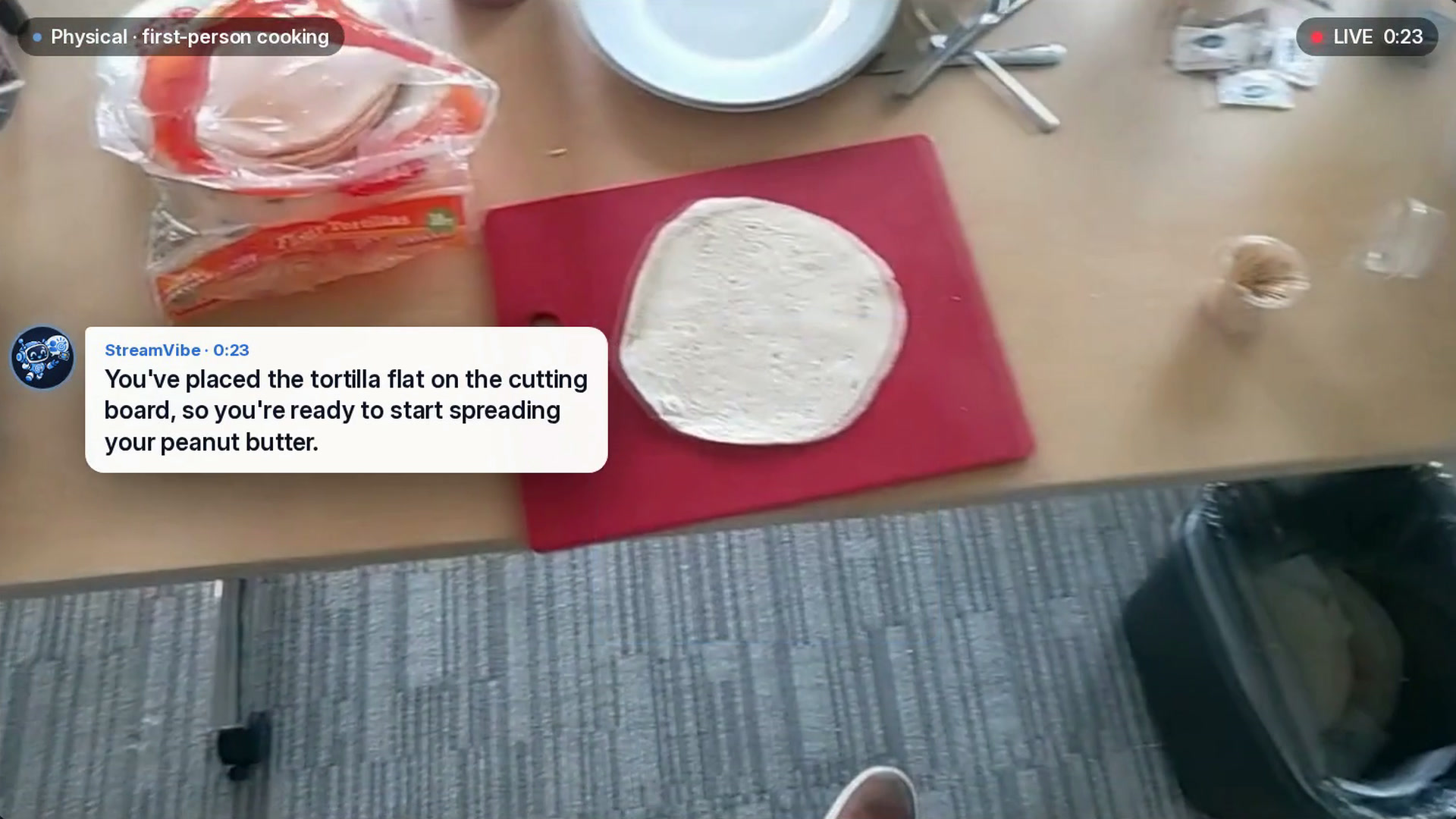
Google StreamVibe Benchmark Tests When Proactive Video AI Should Speak
Google researchers introduced StreamVibe, a video agent that watches tasks like cooking or furniture assembly and speaks only when help is needed. A benchmark cited in reporting covers about four thousand examples from more than one hundred eighty-three hours of recordings and shows models struggling to time interventions on long videos, especially when instructions change mid-task. Attributed coverage says none of the tested models reliably picked the right moment on longer clips, with compounding errors and sharply lower response quality. For builders of proactive video assistants, the signal is that knowing when to stay quiet may matter as much as knowing what to say. Available excerpts do not spell out which models were tested or whether StreamVibe itself was evaluated, leaving part of the failure scope undefined.
Google StreamVibe Benchmark Tests When Proactive Video AI Should Speak
Researchers led by Google introduced StreamVibe, a video agent that decides when to speak during tasks such as cooking or furniture assembly. A benchmark of about 4,100 examples from more than 183 hours of recordings shows models struggle to time help on long videos when instructions change mid-task.
Key takeaway
Proactive video agents may fail in real use when intervention timing is wrong on long tasks, even if spoken answers sound fluent.
What happened
Researchers led by Google introduced StreamVibe, a video agent that decides when to speak during hands-on tasks such as cooking or furniture assembly, according to reporting summarized in the evidence packet.
A benchmark described in the same reporting spans about 4,100 examples drawn from more than 183 hours of recordings and indicates that models struggle to time help on long videos when instructions change mid-task, with none of the tested models reliably choosing the right moment and response quality dropping sharply as errors compound.
Evidence
Google-led researchers built StreamVibe to speak up only when help is needed during activities like cooking or furniture assembly.
The Decoder · attributed
A Google-led research team built StreamVibe, a video agent designed to watch people cook or assemble furniture and speak up only when help is needed.
The StreamVibe benchmark covers roughly 4,100 examples from more than 183 hours of recordings.
The Decoder · attributed
A benchmark of about 4,100 examples from more than 183 hours of recordings shows models struggle to time help on long videos when instructions change mid-task.
None of the models tested in the benchmark reliably picked the right intervention moment on longer videos.
The Decoder · attributed
A benchmark shows that none of the tested models reliably pick the right moment in longer videos, as errors compound and response quality drops sharply.
Alphabet's Google announced a new version of its AI world model for more realistic real-time virtual environments.
Bloomberg Technology · attributed
Alphabet Inc.’s Google announced a new version of its artificial intelligence world model that generates more realistic, real-time virtual environments, advancing a technology that has rattled investors in video game companies.
Why it matters
Intervention timing on long, shifting tasks is a core reliability risk for watch-and-help video agents, not a polish layer on top of chat quality.
Limits and uncertainties
The packet excerpts do not identify which models were tested in the StreamVibe benchmark.
It is unclear from the excerpts whether StreamVibe itself was evaluated or only other models.
Coverage is excerpt-level and does not fully document benchmark methodology.
The Bloomberg world-model item is a separate Google AI story and is not tied in the packet to StreamVibe results.
Practical implications
Treat when-to-speak policies and evaluation on long videos with mid-task instruction changes as release gates for proactive video assistants.
Design product tests that measure compounding timing errors and downstream response quality, not only single-turn answer correctness.