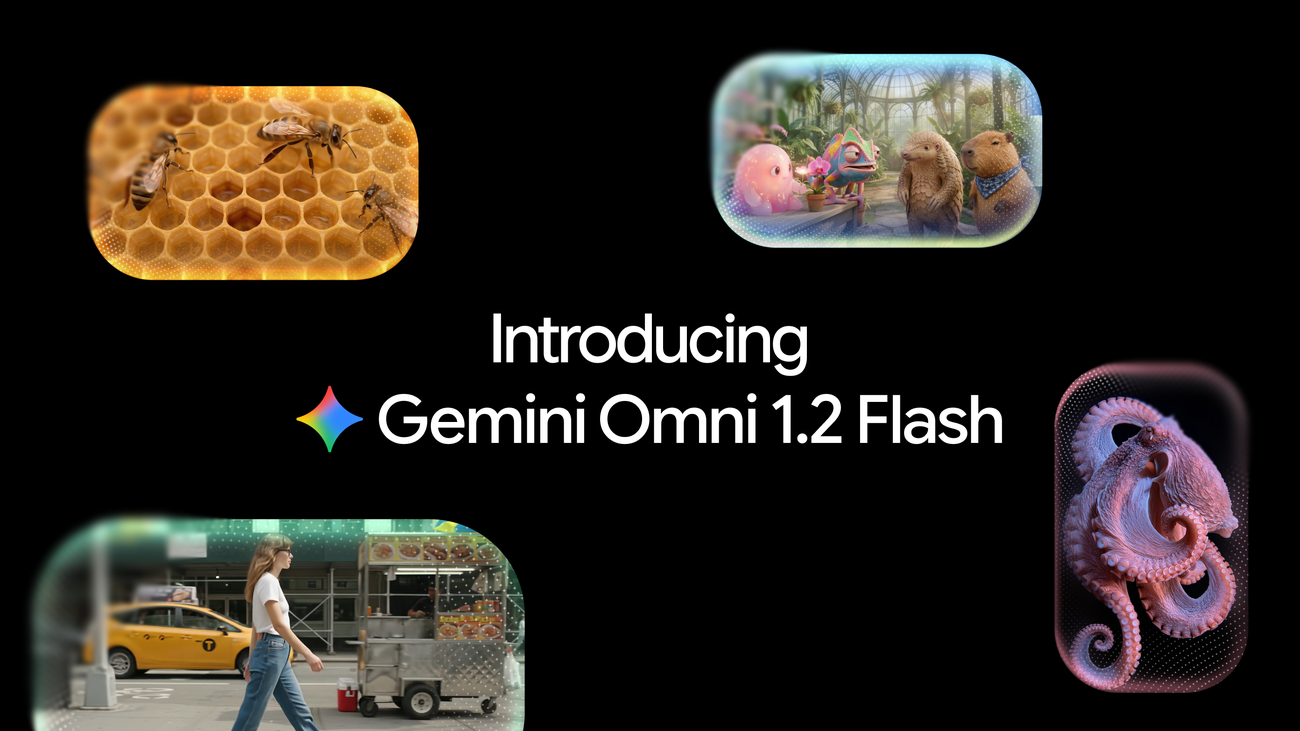
Google launches Gemini Omni 1.2 Flash with 15-second native video and 30% lower pricing
Google’s AI blog introduced Gemini Omni 1.2 Flash with native fifteen-second video generation, stronger consistency, and conversational step-by-step editing, while positioning the release as faster and more cost-effective than earlier tiers. The Decoder reports general availability and a seven-cent-per-second 720p rate, described as thirty percent below its predecessor. Developers and pipeline teams evaluating video APIs can update cost and clip-length planning against those published figures rather than chaining shorter renders, yet the excerpt provides no independent benchmarks, latency measurements, or output-quality assessments to confirm production readiness. Reporting also mentions extra savings from low-resolution drafts with a final upscale, without quantifying them, and the predecessor tier remains underspecified for apples-to-apples pricing checks.
Google launches Gemini Omni 1.2 Flash with 15-second native video and 30% lower pricing
Google announced Gemini Omni 1.2 Flash on its AI blog, highlighting native 15-second video generation and editing, stronger consistency, and pricing 30% below the prior tier. Third-party reporting adds general availability and per-second 720p pricing details for builders weighing production cost.
Key takeaway
Longer native clips and a thirty-percent price cut make Gemini Omni 1.2 Flash worth a fresh look, but cost alone does not prove production readiness.
What happened
Google announced Gemini Omni 1.2 Flash on its AI blog, describing native fifteen-second video generation and editing, stronger consistency, and pricing thirty percent below the prior tier.
The Decoder reports general availability for the video-generation model, clips up to fifteen seconds, step-by-step conversational editing, and $0.07 per second at 720p, thirty percent less than its predecessor, with additional savings possible when users draft in low resolution and upscale only the final result.
Evidence
Google positions Gemini Omni 1.2 Flash around fifteen-second native video, editing, consistency, and lower pricing.
Google AI · attributed
Gemini Omni 1.2 Flash brings native 15-second video generation and editing, stronger consistency, and 30% lower pricing.
Third-party reporting cites general availability, fifteen-second clips, conversational editing, and per-second 720p pricing.
The Decoder · attributed
Google Deepmind is making Gemini Omni 1.2 Flash generally available. The video-generation model now creates clips up to 15 seconds long, can be edited step by step via conversation, and costs just $0.07 per second at 720p, 30 percent less than its predecessor.
Low-resolution drafting with final upscale is presented as a further cost-saving workflow.
The Decoder · attributed
Users who draft in low resolution and upscale only the final result can save even more.
Why it matters
Builders weighing video-generation APIs can rebaseline spend and clip-length assumptions using the published per-second 720p rate and fifteen-second cap, while still needing their own quality and latency checks before committing workflows.
Limits and uncertainties
The available excerpt does not establish output quality, benchmark performance, latency, or real-world adoption.
The thirty-percent price reduction is relative to a predecessor tier that the packet does not fully specify for apples-to-apples comparison.
Savings from low-resolution drafting and final upscale are mentioned but not quantified in the evidence.
Practical implications
Update production cost models with the reported $0.07 per second at 720p and the fifteen-second clip limit when scoping short-form video features.
Pilot conversational step-by-step editing flows before relying on them in automated pipelines.
Run internal quality and latency validation rather than treating announcement specs as production guarantees.
What to watch
Independent benchmarks on visual quality, consistency, and generation latency for fifteen-second 720p clips.
Clearer regional availability and API access terms beyond general availability claims in third-party reporting.
Documented comparisons of effective cost versus competing video-generation APIs at similar resolution and clip length.