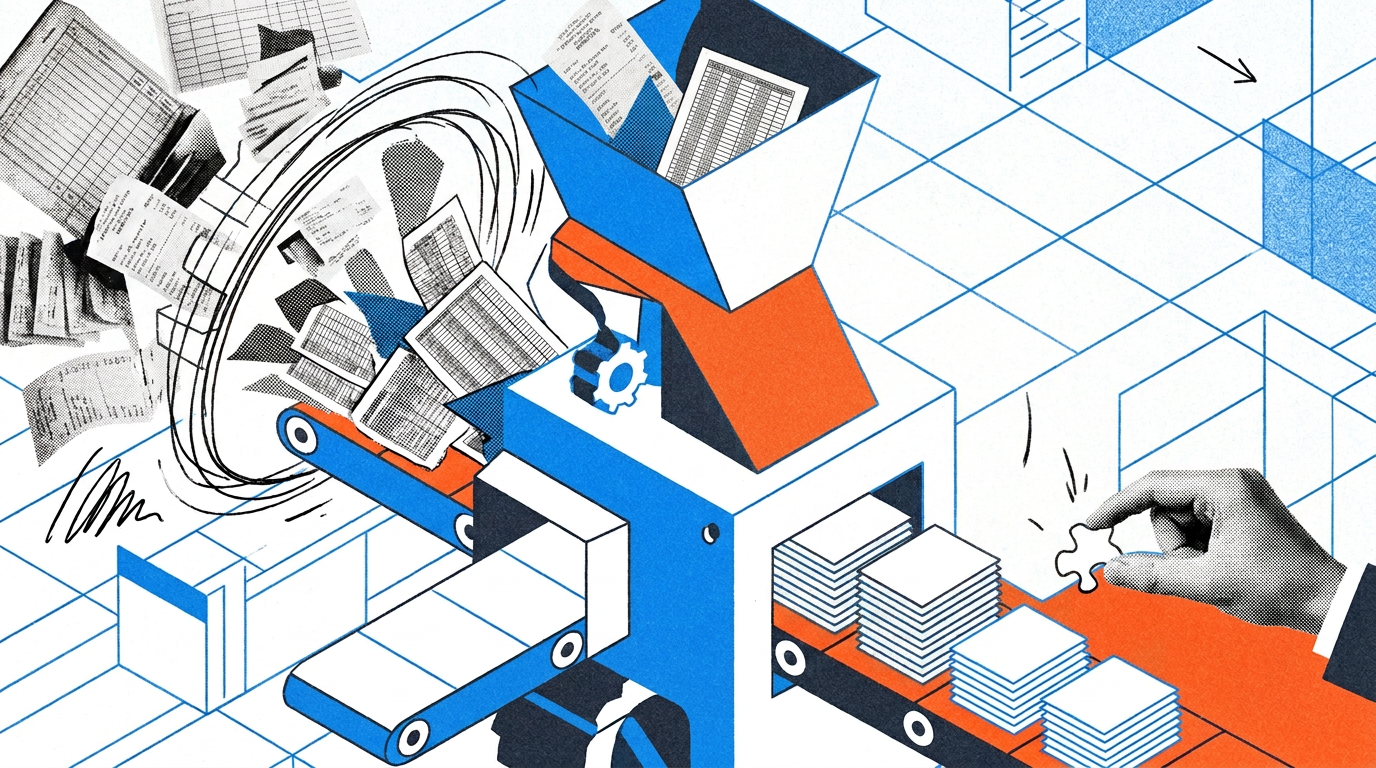
Mercor study: AI tops licensed CPAs on simplified accounting tasks but not full APEX close
Mercor research summarized by The Decoder indicates that current AI models now exceed licensed CPAs on structured accounting work for both speed and accuracy, a sharp reversal from roughly eighteen months earlier when models reportedly lagged far behind. That progress does not extend to full-period close: on the more demanding APEX Benchmark, no model completed every task, and reporting stresses that without human oversight AI still cannot close the books independently. For finance and product teams, the useful reading is bifurcated capability, strong on routinized workflows and weak on end-to-end close, rather than blanket automation. The available packet is excerpt-level coverage of one study relayed through a single outlet, so methodology, model list, CPA baselines, and task definitions remain unstated here.
Mercor study: AI tops licensed CPAs on simplified accounting tasks but not full APEX close
According to a Mercor study, current AI models now outperform licensed CPAs on structured accounting tasks in both speed and accuracy. On the more demanding APEX Benchmark, though, no model fully completes all the tasks.
Key takeaway
Structured accounting automation is now competitive with licensed CPAs on speed and accuracy, but full close workflows still need humans in the loop.
What happened
The Decoder reports that a Mercor study found current AI models outperform licensed CPAs on structured accounting tasks in both speed and accuracy, whereas about eighteen months ago those models still lagged far behind on the same class of work.
On the more demanding APEX Benchmark, no model fully completes all tasks, and the coverage states that without human oversight AI still cannot close the books on its own.
Evidence
Mercor study reports AI models beat licensed CPAs on structured accounting tasks for speed and accuracy.
The Decoder · attributed
According to a Mercor study, current AI models now outperform licensed CPAs on structured accounting tasks in both speed and accuracy.
Roughly eighteen months ago, AI reportedly lagged far behind licensed CPAs on this work.
The Decoder · attributed
Eighteen months ago, they still lagged far behind.
On the APEX Benchmark, no model fully completes all tasks.
The Decoder · attributed
On the more demanding APEX Benchmark, though, no model fully completes all the tasks.
AI cannot close the books without human oversight.
The Decoder · attributed
Without human oversight, AI still can't close the books on its own.
Why it matters
The gap between AI and credentialed accountants on routine tasks has narrowed quickly, which should reset expectations for finance automation roadmaps without removing review gates on close.
Limits and uncertainties
The packet is excerpt-level news coverage of a Mercor study and does not establish methodology, sample size, which models were tested, how licensed CPAs were measured, or how structured accounting tasks were defined.
The eighteen-month comparison is cited without a defined baseline or underlying data in the available text.
Practical implications
Treat AI as a fast, accurate assistant for structured accounting workflows while retaining human oversight for period close and other APEX-scale task sets.
Do not assume full books-close automation is viable from headline-level benchmark claims without verifying study design and your own close checklist.
What to watch
Whether Mercor or others publish full APEX Benchmark results with model names, task definitions, and CPA comparison protocol.
Whether finance teams adopt AI on structured tasks while keeping explicit human sign-off on close until benchmark gaps are closed.