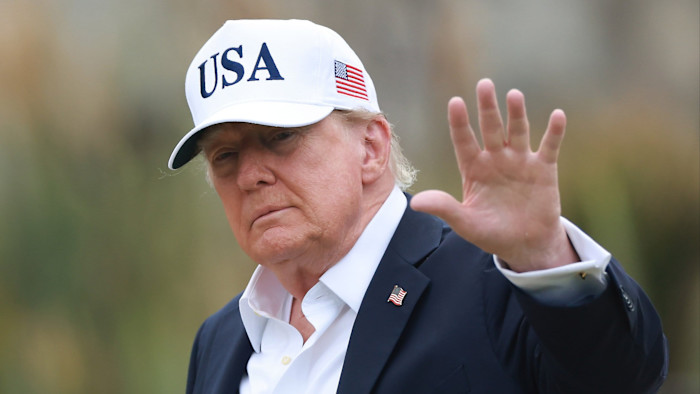
President Trump publicly rejected appeals from technology leaders for a slowdown in artificial intelligence development, telling reporters that advocates for restraint represent negative forces that should not be driving the conversation. Financial Times reporting frames his remarks as a denunciation of demands for regulation, as existential anxiety about advanced technology moves to the center of United States politics. The exchange lands amid a widening industry split: Anthropic chief executive Dario Amodei argued in a recent essay for stronger safety controls as capabilities accelerate, while other Silicon Valley figures have questioned slowdown calls as self-serving. Trump gave no new regulatory blueprint, and coverage does not spell out which leaders he was answering or what specific rules he rejected, leaving open whether the stance is durable policy or campaign rhetoric.
President Trump dismisses calls for an AI slowdown, saying "you have a lot of negative forces that are bringing it up that shouldn't be bringing it up". President denounces demands for regulation as existential fears over technology move to the centre of US politics.
Key takeaway
US political leadership is openly siding with acceleration, dismissing industry slowdown appeals as illegitimate obstruction rather than credible safety policy.
What happened
President Trump dismissed calls for an artificial intelligence slowdown, saying you have a lot of negative forces that are bringing it up that should not be bringing it up, according to Financial Times reporting aggregated by Techmeme. The same coverage says he denounced demands for regulation as existential fears over technology move to the centre of US politics.
The political rejection arrives as Anthropic CEO Dario Amodei published an essay calling for greater safety controls across the industry as AI capabilities advance rapidly, per New York Times reporting. Separately, the New York Times reported that some Silicon Valley leaders are questioning slowdown calls, arguing demands for government regulation are self-serving and misplaced.
Evidence
President Trump rejected calls for an AI slowdown and attributed those appeals to negative forces.
Financial Times Technology · attributed
President Trump dismisses calls for an AI slowdown, saying "you have a lot of negative forces that are bringing it up that shouldn't be bringing it up"
Trump framed demands for AI regulation as existential fears moving to the center of US politics.
Financial Times Technology · attributed
President denounces demands for regulation as existential fears over technology move to the centre of US politics
Anthropic CEO Dario Amodei called for greater industry-wide safety controls as AI capabilities advance.
NYTimes Technology · attributed
In an essay, the head of Anthropic laid out the rapidly advancing capabilities of artificial intelligence and said there needed to be greater safety controls across the industry.
Some Silicon Valley leaders pushed back against slowdown and regulation calls as self-serving.
NYTimes Technology · attributed
The debate over the safety of artificial intelligence grew personal as key tech leaders said calls for government regulation were self-serving and misplaced.
Financial Times newsletter coverage reported Trump rejected appeals from tech leaders for an AI slowdown.
Financial Times Technology · attributed
Donald Trump has rejected appeals from tech leaders advocating for a slowdown in AI development.
Why it matters
Builders face a bifurcated landscape: permissive federal rhetoric alongside intensifying industry fights over who defines credible safety standards and acceptable deployment pace.
Limits and uncertainties
Financial Times excerpts do not identify which tech leaders made the slowdown appeals or which specific regulatory mechanisms Trump rejected.
Washington Post and several aggregator excerpts in the packet are headline-only and do not substantiate detailed policy shifts beyond Trump's public remarks.
Coverage does not clarify whether Trump's statement reflects a formal policy change or rhetorical positioning ahead of broader political debate.
Practical implications
Operators should not assume near-term federal slowdown mandates, but should still plan for enterprise and international safety expectations that may diverge from US political rhetoric.
Teams shipping frontier models should track whether industry safety advocacy from labs like Anthropic translates into concrete compliance requirements or remains contested opinion.
Product and policy teams need stronger internal governance documentation because external oversight debates are becoming ideological rather than narrowly technical.
What to watch
Whether the Trump administration issues concrete AI regulatory proposals or executive actions beyond dismissive public statements.
How bipartisan lawmakers respond as existential fears over technology move to the center of US politics.
Whether Anthropic's safety-controls essay spurs coordinated industry standards or further Silicon Valley pushback framing regulation as self-serving.
Original reporting: President Trump dismisses calls for an AI slowdown, saying "you have a lot of negative forces that are bringing it up that shouldn't be bringing it up" (Financial Times)