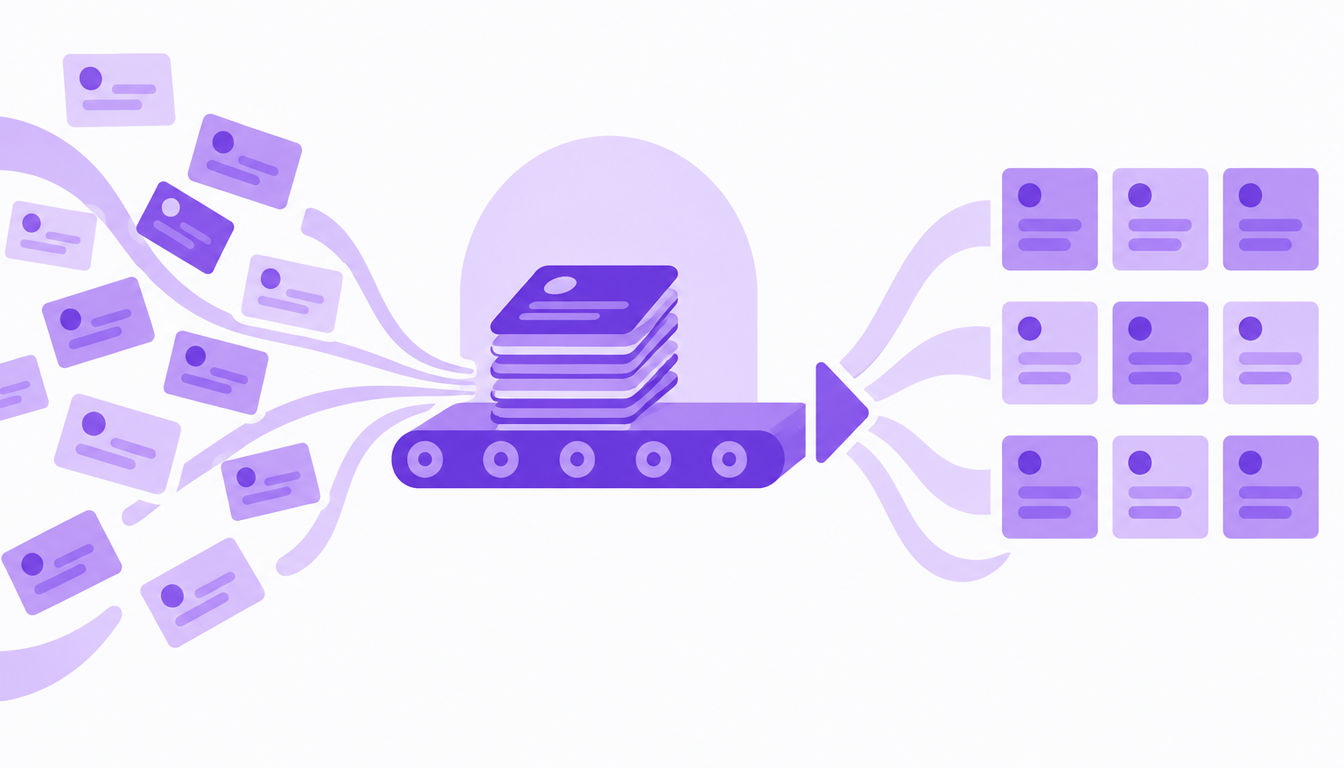
OpenRouter Batch API bundles async inference at about half per-token price on 70+ models
OpenRouter introduced a Batch API for workloads that can wait up to 24 hours, letting you submit an entire job in one POST and collect results asynchronously. OpenRouter reports that providers typically charge half or less of normal per-token rates, with support on more than seventy models today. During a two-week beta, over 230,000 completed batches saw a median finish time of seven minutes and ninety percent completed within an hour. The pattern mirrors familiar batch-discount economics for offline pipelines such as bulk embedding or evaluation runs, but actual pricing still varies by provider and model rather than a single flat discount everywhere.
OpenRouter Batch API bundles async inference at about half per-token price on 70+ models
OpenRouter says you can now use the new batch API for workloads that can wait up to 24 hours, with providers generally charging 50% or less of normal per-token rates. It works today on more than 70 models, and across 230k+ completed beta batches the median finish time was 7 minutes with 90% done within an hour.
Key takeaway
Teams with deferrable inference can cut per-token spend roughly in half by moving eligible jobs off synchronous routes onto OpenRouter’s batch endpoint.
What happened
OpenRouter announced a new Batch API that accepts a full workload in a single POST and returns results asynchronously, with a stated window of up to 24 hours for completion.
The service is available on more than 70 models, with providers generally charging 50% or less of normal per-token rates; OpenRouter cites beta data from 230k+ completed batches with a median finish time of 7 minutes and 90% done within an hour.
Evidence
Batch jobs can wait up to 24 hours and are submitted in one POST.
OpenRouter · attributed
Send a whole workload in one POST, collect the results within 24 hours, and typically pay half the per-token price.
Pricing is generally half or less of normal per-token rates on 70+ models.
OpenRouter · attributed
OpenRouter says you can now use the new batch API for workloads that can wait up to 24 hours, with providers generally charging 50% or less of normal per-token rates. It works today on more than 70 models
Beta completion times were much faster than the 24-hour ceiling for most batches.
OpenRouter · attributed
Across 230k+ completed beta batches the median finish time was 7 minutes with 90% done within an hour.
Why it matters
OpenRouter is positioning batch bundling as a standard cost lever for agent and pipeline operators who can separate latency-sensitive calls from overnight or queue-driven work.
Limits and uncertainties
The 24-hour completion window is a hard suitability constraint for interactive or real-time flows.
Discount levels are described as provider-dependent (50% or less), not a guaranteed uniform rate on every model.
Latency and throughput statistics come from a two-week beta cohort and may shift under general availability load.
Practical implications
Audit workloads for 24-hour tolerance and migrate bulk embedding, eval, and offline generation to the Batch API where models are supported.
Keep latency-critical paths on synchronous inference and compare per-model batch eligibility before committing spend forecasts.
What to watch
Whether model coverage beyond the initial 70+ set expands and which providers publish explicit batch rate cards.
Median and p90 batch completion times under production traffic versus the cited beta medians.
Any changes to the 24-hour SLA or pricing caps after GA adoption scales.