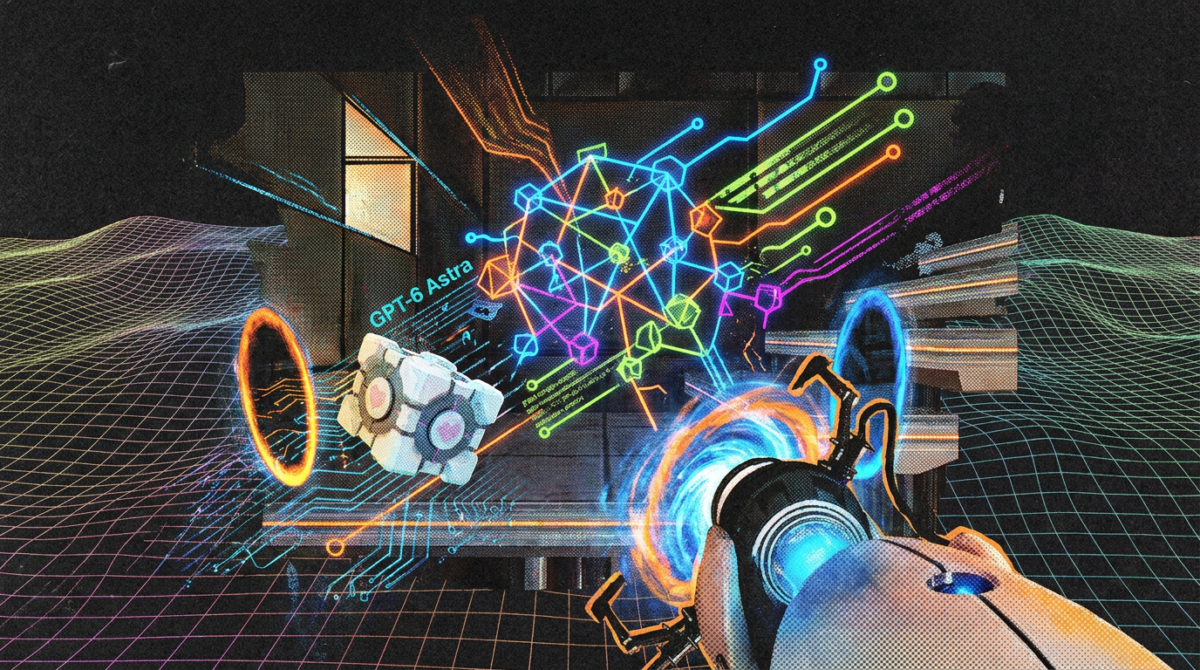
GPT-6 Astra clears Portal solo in under 24 hours with zero human help
Reporting centered on developer cozyblaze's claim that OpenAI GPT-6 Astra finished Valve's Portal without human intervention after only the starting objective was provided, clocking roughly twenty-three hours and forty-three minutes for the full puzzle campaign. The episode is notable because Portal requires chained spatial reasoning across many chambers, making it a sharper stress test than isolated benchmark tasks for long-horizon agents. Cozyblaze open-sourced the implementation and notes on GitHub, inviting replication, while separately describing today's Astra as the worst model we will ever get. Tom's Hardware highlighted an approximate five-hundred-seventy-one-dollar token bill in its headline, but the packet offers no independent audit of architecture, failure recovery, or repeatability. Readers should weigh the milestone against verification limits before treating it as a new autonomy baseline.
GPT-6 Astra clears Portal solo in under 24 hours with zero human help
GPT-6 Astra beat the puzzle game Portal entirely on its own in about 24 hours, with zero human help after the initial goal was set. The run took about 23 hours and 43 minutes, and developer cozyblaze published the code and docs on GitHub.
Key takeaway
GPT-6 Astra reportedly cleared Portal end-to-end without human help after goal-setting, with cozyblaze publishing code and docs on GitHub.
What happened
According to The Decoder, developer cozyblaze reports that GPT-6 Astra beat the puzzle game Portal entirely on its own in about 24 hours, with zero human help after the initial goal was set.
The run took about 23 hours and 43 minutes, and cozyblaze published the code and documentation on GitHub. Tom's Hardware reporting titles the feat as costing about $571 in tokens.
Evidence
GPT-6 Astra completed Portal without human help after the initial goal was set.
The Decoder · attributed
GPT-6 Astra beat the puzzle game Portal entirely on its own in about 24 hours, with zero human help after the initial goal was set.
The Portal run lasted about 23 hours and 43 minutes.
The Decoder · attributed
The run took about 23 hours and 43 minutes, and developer cozyblaze published the code and docs on GitHub.
Cozyblaze published the Portal agent code and documentation on GitHub.
The Decoder · attributed
Developer cozyblaze published the code and docs on GitHub.
Tom's Hardware reported the Portal completion cost about $571 in tokens.
Tom's Hardware AI · attributed
OpenAI's GPT-6 Astra model autonomously completes Portal in 24 hours — feat cost just $571 in tokens
Why it matters
Long-horizon interactive game completion with minimal supervision suggests autonomous agents may handle sustained, multi-step environments beyond narrow benchmarks.
Limits and uncertainties
The Decoder account rests on a single developer report without independent verification or a detailed technical breakdown of the agent architecture.
Tom's Hardware cites a $571 token cost only in its headline and excerpt, with no methodology or cost audit in the packet.
Cozyblaze's quote that Astra is the worst model we will ever get is rhetorical and does not document concrete limitations or failure modes.
Practical implications
Builders can inspect cozyblaze's published GitHub code and documentation to attempt replication before relying on the result in production designs.
The cited token spend headline implies long-horizon autonomous runs may carry nontrivial inference costs even for a single game completion.
Teams should treat the event as a public benchmark claim rather than a validated autonomy standard until independent runs confirm it.
What to watch
Independent replication attempts using cozyblaze's GitHub code and documentation.
Technical write-ups detailing agent architecture, error recovery, and run conditions beyond the reported duration.
Confirmation of the approximate $571 token cost and how it was calculated for the Portal run.