Z.ai releases GLM-5.3 with frontier agentic coding benchmarks
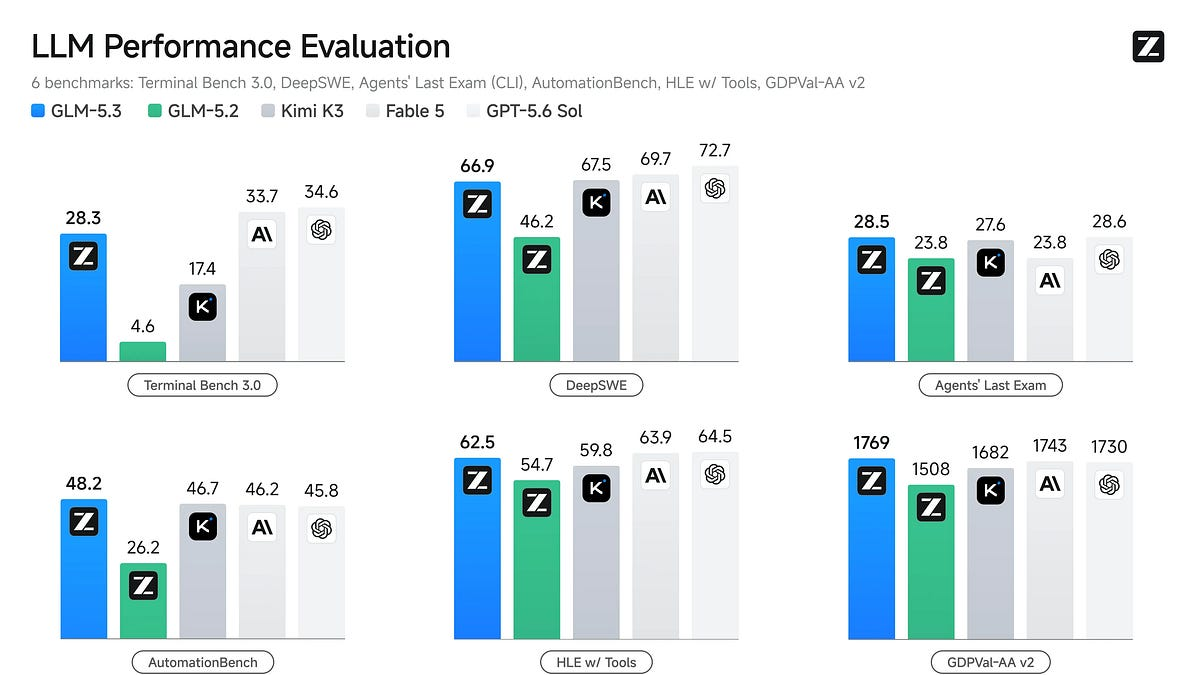
Z.ai has unveiled GLM-5.3, a model that places it at the frontier of agentic coding benchmarks using only about 750 billion parameters — a third of Moonshot AI's Kimi K3. It surpasses Kimi K3 on many benchmarks and even beats Claude Fable 5 or GPT-5.6-Sol on some. Currently available only in the coding plan, the model is coming to the API soon, with open weights on Hugging Face in two weeks. Built on the same base as GLM-5.2, its gains stem from substantially extended post-training, not distillation. This release illustrates how Chinese labs narrow the gap by capitalizing on the time American firms spend on pre-release testing to keep hillclimbing benchmarks, and by leveraging RL environments sourced from American data companies. The results raise questions about benchmaxxing, underscoring the need for independent verification of benchmark claims.
Z.ai releases GLM-5.3 with frontier agentic coding benchmarks
Today, Z.ai announced their GLM-5.3 model, currently only available in the coding plan, coming soon to their API and in two weeks’ time to Hugging Face. On many benchmarks the model has surpassed Moonshot AI’s Kimi K3 and on some it’s surpassed Claude Fable 5 or GPT-5.6-Sol. This puts the model more or less at the frontier of agentic coding benchmarks, with only ~750B parameters.
Key takeaway
The US-China AI gap is narrowing not through imitation, but through parallel optimization strategies and a shared, commercialized data infrastructure.
What happened
Z.ai announced GLM-5.3, a model that now leads frontier agentic coding benchmarks with only about 750 billion parameters. It surpasses Moonshot AI's Kimi K3 on many benchmarks and even outperforms Claude Fable 5 or GPT-5.6-Sol on some, according to Interconnects' coverage.
The model is currently available only in the coding plan, with API access expected soon and open weights on Hugging Face in two weeks. GLM-5.3 shares the same base as GLM-5.2, with gains driven by extended post-training. The analysis suggests Chinese labs close the gap by using the time American labs spend on pre-release testing to keep optimizing and by leveraging RL environments sourced from US data companies.
Evidence
Z.ai's GLM-5.3 surpasses Moonshot AI's Kimi K3 on many benchmarks and some benchmarks exceed Claude Fable 5 or GPT-5.6-Sol.
Interconnects · attributed
On many benchmarks the model has surpassed Moonshot AI’s Kimi K3 and on some it’s surpassed Claude Fable 5 or GPT-5.6-Sol.
GLM-5.3 is the same base model as GLM-5.2 with substantially extended post-training.
Interconnects · attributed
GLM-5.3 is the same base model as GLM-5.2 with substantially extended post-training.
Chinese labs likely leverage RL environments purchased from American data companies.
Interconnects · attributed
The model likely leverages RL environments purchased from American data companies.
Why it matters
For builders and operators, the release signals a permanent shift: they must plan for Chinese models matching US frontier performance on key benchmarks, making unique integration and data leverage the competitive differentiator rather than raw model quality.
Limits and uncertainties
The model is currently restricted to the coding plan, limiting assessment of its general capabilities.
The article discusses the possibility of benchmaxxing, meaning benchmark scores may not fully reflect real-world performance.
Practical implications
Operators should plan for Chinese models to match US frontier capabilities in coding benchmarks, so competitive strategy should shift toward unique integration and fast deployment.
Given the faster release cycle, teams should consider adopting and testing Chinese models early to stay ahead.
The reliance on US-sourced RL environments suggests data supply chains are critical; builders should consider dependencies.
What to watch
Watch for GLM-5.3's open-weight release on Hugging Face in two weeks and independent benchmark evaluations.
Monitor whether Z.ai expands availability beyond the coding plan to its API.
Track whether other Chinese labs adopt similar post-training scaling strategies.