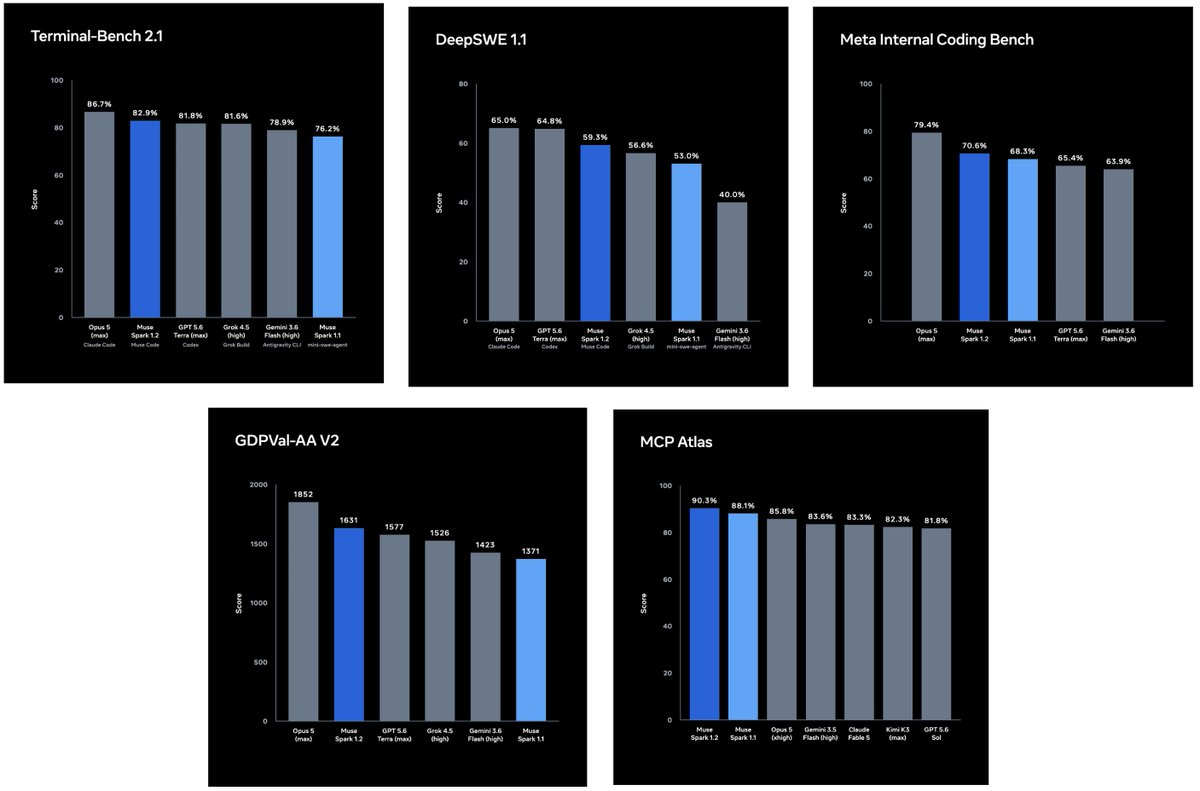
Muse Spark 1.2 arrives as a follow-on release to version 1.1, framed around sharper capabilities for coding pipelines and general agent workloads. Muse Code debuts in beta as execution scaffolding for demanding software engineering problems, with messaging that stresses efficient, robust handling of complex multi-step work. The joint announcement ties model refresh to operational tooling, suggesting Muse aims to cover both inference quality and task orchestration for builders shipping real code changes. Readers should treat Muse Code as early-stage beta harness software rather than a finished product surface. Available reporting rests on a single owned-news X announcement; the packet does not document benchmark scores, commercial terms, context windows, or integration paths beyond the paired launch framing.
Muse Spark 1.2 is an upgrade to 1.1 with overall improvements in coding and general agents. Muse Code is a harness designed for efficiently and robustly solving complex software engineering tasks.
Key takeaway
Muse Spark 1.2 pairs a refreshed coding-and-agent model with Muse Code, a beta harness aimed at complex software engineering workloads.
What happened
According to an owned-news post on X, Muse Spark 1.2 and Muse Code beta were announced together, with Spark 1.2 described as an upgrade to version 1.1.
The same reporting states Spark 1.2 brings overall improvements in coding and general agents, while Muse Code is a harness designed for efficiently and robustly solving complex software engineering tasks and was released in beta.
Evidence
Muse Spark 1.2 and Muse Code beta were announced together.
x.com · attributed
Muse Spark 1.2 and Muse Code beta announced
Muse Spark 1.2 is an upgrade to 1.1 with improvements in coding and general agents.
x.com · attributed
Muse Spark 1.2 is an upgrade to 1.1 with overall improvements in coding and general agents.
Muse Code is a harness for complex software engineering tasks.
x.com · attributed
Muse Code is a harness designed for efficiently and robustly solving complex software engineering tasks.
Muse Code was released in beta.
x.com · attributed
Muse Spark 1.2 and Muse Code were announced together, with Muse Code released in beta.
Why it matters
The launch bundles a model upgrade with task harness infrastructure, which may matter for teams evaluating agent stacks that need orchestration beyond a standalone chat model.
Limits and uncertainties
Reporting comes from a single X post in the owned-news packet, without benchmarks, pricing, context limits, or API details.
Muse Code is explicitly beta, so stability and production readiness are not established in the available materials.
Practical implications
Builders weighing Muse for coding agents can compare Spark 1.2 against prior 1.1 capabilities for coding and general-agent use cases.
Operators should pilot Muse Code as beta harness software for complex software engineering tasks before relying on it in production workflows.
What to watch
Independent benchmarks or evaluations of Muse Spark 1.2 coding and general-agent performance versus version 1.1.
Documentation on Muse Code harness APIs, integration paths, and progression from beta to general availability.