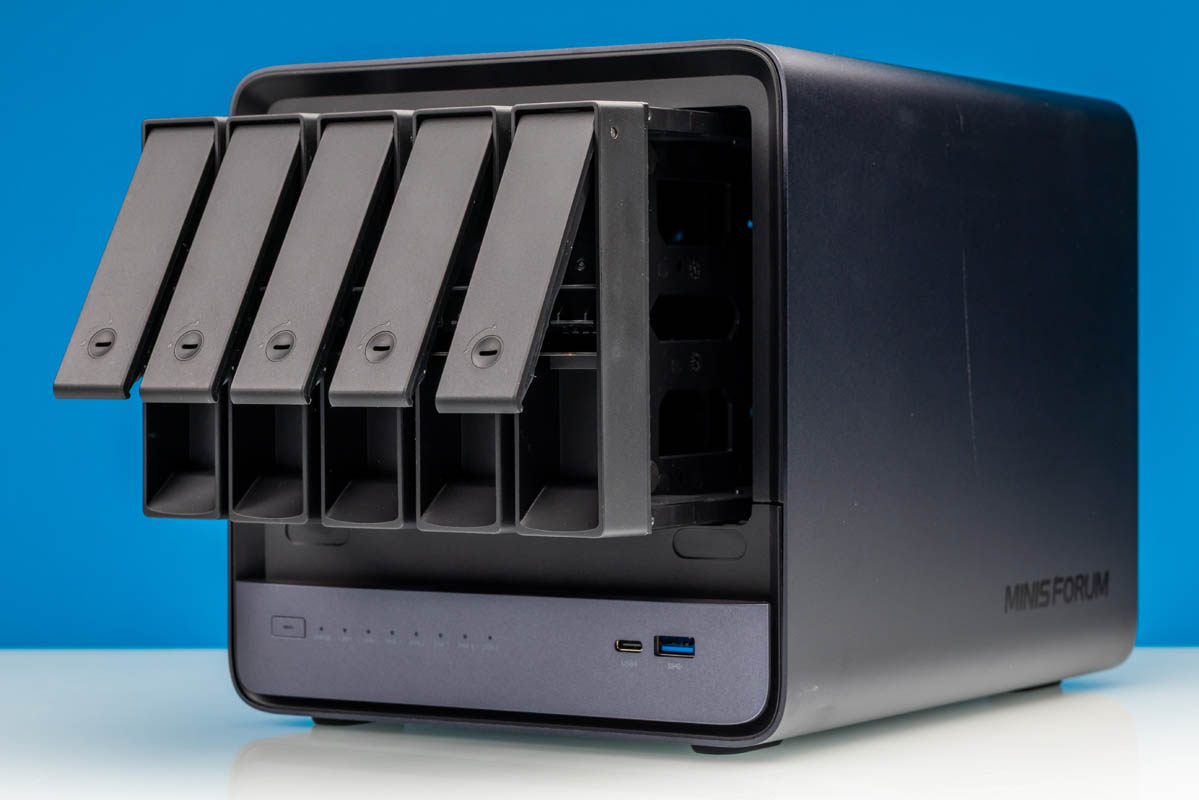
Minisforum N5 Max review: Ryzen AI Max+ 395 in a five-bay NAS with measured AI power draw
ServeTheHome's review of the Minisforum N5 Max shows that a five-bay NAS can now house AMD's 16-core Ryzen AI Max+ 395 with 64GB LPDDR5X and a Radeon 8060S GPU, delivering dual 10GbE and local AI inference in one box. Measured power draw without drives hit about 90W during AI inference and 110-120W under heavier CPU load, with a 165W peak, leaving headroom under the built-in 250W PSU. The system packs five 3.5-inch bays and five M.2 slots, though only one M.2 runs at PCIe 4.0 x4. However, reviewers caution that MinisCloud software is weak, recommending Ubuntu or Proxmox VE instead, and note that LPDDR5X used for ZFS cache may compete with AI memory needs.
Minisforum N5 Max review: Ryzen AI Max+ 395 in a five-bay NAS with measured AI power draw
ServeTheHome: “Folding a 16-core, 32-thread Strix Halo processor, dual 10GbE networking, 64GB of LPDDR5X memory, and the Radeon 8060S GPU into a five-bay NAS creates a do-everything machine. Without drives installed, AI inference drew around 90W, and a heavier CPU load hit 110-120W, with a 165W peak noted during testing.”
Key takeaway
A five-bay NAS with AMD's Strix Halo processor can run local AI models at about 90W, but shared LPDDR5X between ZFS cache and GPU memory means separate machines may still be better.
What happened
ServeTheHome reviewed the Minisforum N5 Max, a five-bay NAS built around AMD's Ryzen AI Max+ 395 (Strix Halo) with 16 cores, 32 threads, 64GB of LPDDR5X, a Radeon 8060S GPU, and dual 10GbE networking. The unit includes a built-in 250W power supply, a change from its predecessor, and without drives it idled around 30-35W, while AI inference drew roughly 90W and heavier CPU loads 110-120W, with a 165W peak recorded.
The review notes that storage drive activity raised wall power to 50-60W and installed drives made more noise. While the hardware is praised as a do-everything machine, reviewers disliked the MiniCloud software, which tripped Windows Defender, and recommend installing Ubuntu or Proxmox VE instead. They also question mixing ZFS and AI in one box, since LPDDR5X is shared between storage cache and GPU memory, and suggest 128GB would be a better option but memory prices made it impractical.
Evidence
Without drives installed, AI inference drew around 90W, and a heavier CPU load hit 110-120W, with a 165W peak noted during testing.
Servethehome · attributed
Without drives installed, AI inference drew around 90W, and a heavier CPU load hit 110-120W, with a 165W peak noted during testing.
MinisCloud software is not recommended; reviewers suggest Ubuntu or Proxmox VE instead.
Servethehome · attributed
The MinisCloud software is still not something we can recommend, just given that it is not something we would use over Ubuntu (what we ultimately used) or Proxmox VE.
Why it matters
As AI inference moves into network-attached storage, the shared LPDDR5X trade-off between ZFS caching and GPU memory could force admins to rethink single-box convergence, especially for large models.
Limits and uncertainties
Power draw measurements were taken without drives installed, so real-world deployments with spinning disks will consume more.
The review is based on a single unit and subjective assessment of noise and software.
The 165W peak was noted, but sustained power in mixed workloads is not fully detailed.
Practical implications
When planning a NAS+AI box, account for ZFS cache memory competing with GPU memory; consider separate machines or more RAM.
Skip the bundled MiniCloud software and install Ubuntu or Proxmox VE directly to avoid security and usability issues.
Check M.2 lanes: only one M.2 slot is PCIe 4.0 x4, which may bottleneck fast NVMe drives.
What to watch
Watch for Minisforum releasing a 128GB version of the N5 Max as memory prices fall.
Watch for reviews of competing Strix Halo NAS devices that address shared memory and software issues.
Watch for updates to MiniCloud or adoption of TrueNAS licensing as suggested.