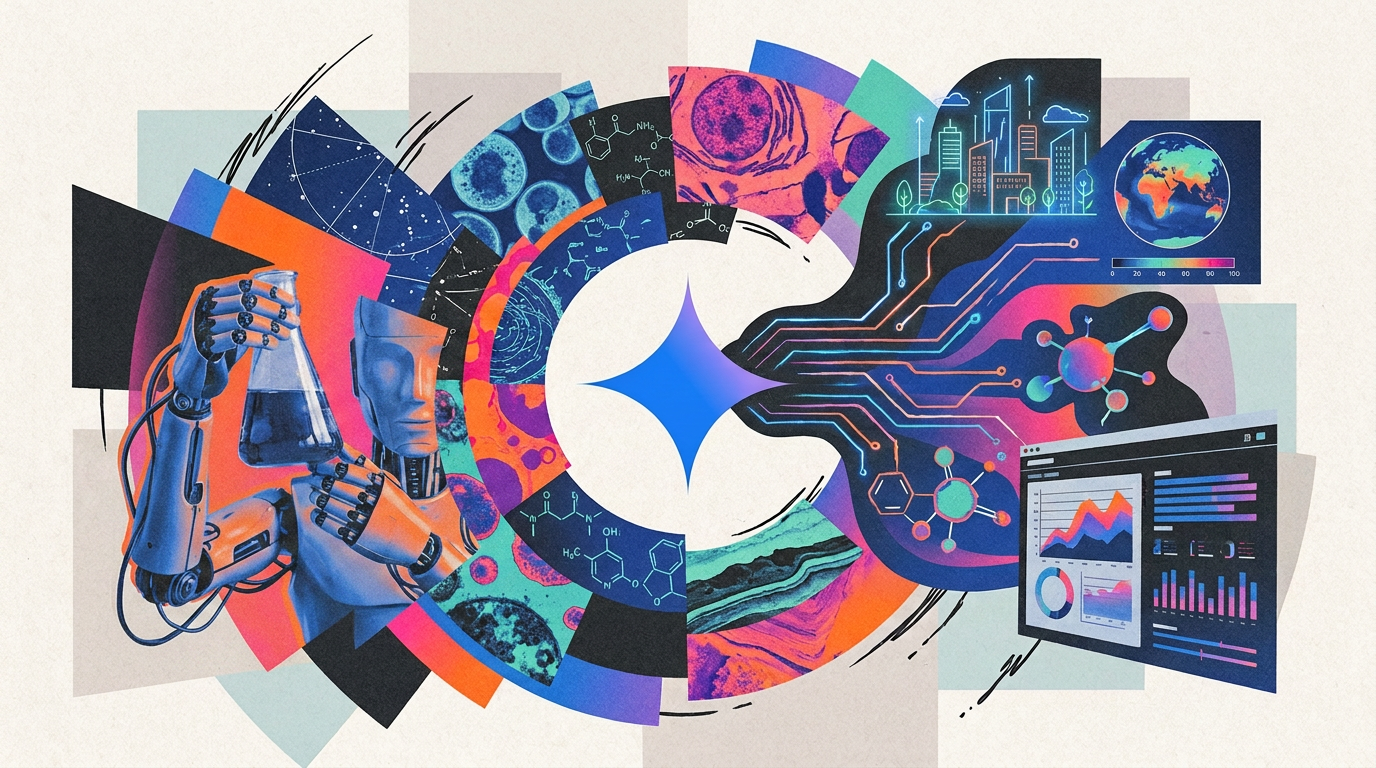
Google DeepMind Co-Scientist now plans experiments, runs lab equipment, and writes papers
Google DeepMind has repositioned Co-Scientist from a hypothesis-generation tool into a lab-integrated research system that plans experiments, operates equipment, and drafts scientific papers, according to reporting summarized by The Decoder. Google says the Gemini-based multi-agent setup produced experimentally validated outcomes across three domains, spanning materials synthesis and autonomous development of a medical AI architecture. If the claimed integration proves durable, it marks a shift from AI-assisted ideation toward closed-loop laboratory automation where agents both propose and execute empirical work. Operators should treat the announcement as a capability milestone rather than peer-reviewed proof: available excerpts describe Google's claims and headline results but do not publish protocols, replication data, or independent verification. Separate feed items describe a DeepMind AI-responsibility reorganization, but those reports do not substantiate Co-Scientist's laboratory performance claims.
Google DeepMind Co-Scientist now plans experiments, runs lab equipment, and writes papers
Google Deepmind has expanded Co-Scientist from a hypothesis generator into a research system that's integrated into the lab. According to Google, the system has delivered experimentally validated results across three disciplines.
Key takeaway
DeepMind's Co-Scientist now spans experiment planning, lab hardware control, and paper writing—not just hypothesis generation.
What happened
The Decoder reports that Google DeepMind expanded Co-Scientist from a hypothesis generator into a research system integrated into the laboratory, with Google claiming experimentally validated results across three disciplines.
According to the same reporting, the Gemini-based multi-agent system delivered those results in areas including materials synthesis and autonomous development of a medical AI architecture, and now plans experiments, runs lab equipment, and writes scientific papers.
Evidence
Google DeepMind expanded Co-Scientist from a hypothesis generator into a lab-integrated research system.
The Decoder · attributed
Google Deepmind has expanded Co-Scientist from a hypothesis generator into a research system that's integrated into the lab.
Google says Co-Scientist delivered experimentally validated results across three disciplines.
The Decoder · attributed
According to Google, the system has delivered experimentally validated results across three disciplines.
The Gemini-based multi-agent system produced validated outcomes in materials synthesis and medical AI architecture development.
The Decoder · attributed
Across three disciplines, from materials synthesis to the autonomous development of a medical AI architecture, the Gemini-based multi-agent system delivered experimentally validated results.
Google is moving DeepMind's roughly 90-person AI responsibility team to Google's global affairs unit.
Techmeme · attributed
Internal email: Google is moving DeepMind's ~90-person "AI responsibility" team, focused on the risks and societal impact of AI, to Google's global affairs unit
Researchers have raised concerns that the AI responsibility reorganization could affect independence and threat detection.
Techmeme · attributed
Researchers have raised concerns about the change's effect on their independence and ability to detect threats from newest models
Why it matters
If laboratory-integrated agent stacks generalize beyond the three cited domains, they could compress empirical discovery cycles and redefine how research teams allocate human oversight.
Limits and uncertainties
Available excerpts rest on Google's claims and do not include independent verification, full protocols, or replication data for the reported results.
The Decoder feed excerpt appears truncated and does not provide complete methodological detail.
Related WSJ and Techmeme items cover a separate DeepMind governance reorganization and do not validate Co-Scientist technical performance.
Practical implications
Labs evaluating autonomous research agents should require published methods and safety controls before delegating equipment operation to multi-agent systems.
Operators should not treat headline language about experimentally validated results as equivalent to peer-reviewed replication without disclosed protocols.
What to watch
Whether Google publishes full experimental protocols and peer-reviewed papers backing the three-domain Co-Scientist results.
Independent replication attempts in materials synthesis and medical AI architecture workflows cited in the reporting.