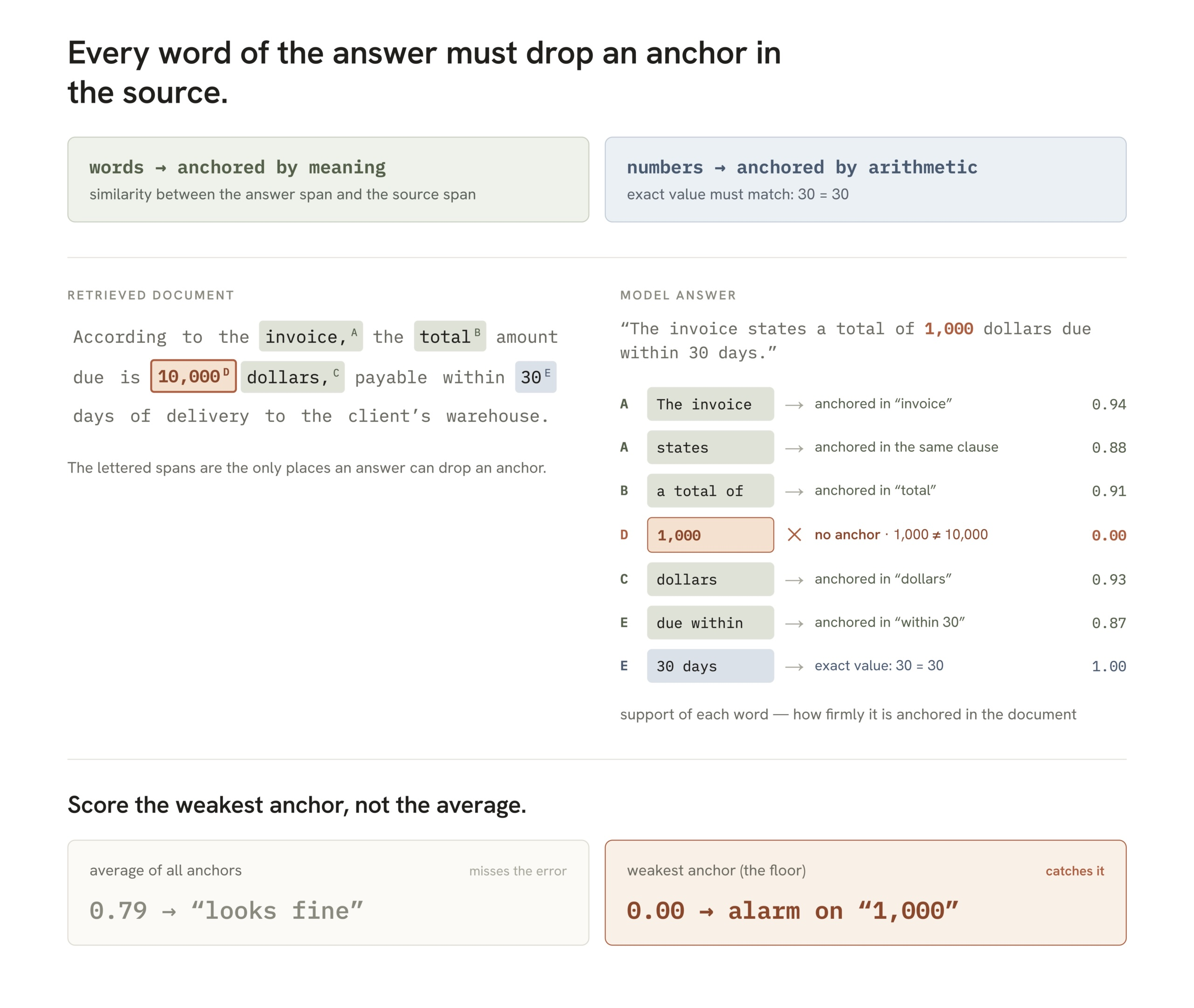
Four of five RAG hallucination detectors miss single-digit number swaps
Research on Towards Data Science using the RAGTruth corpus shows that four of five evaluated RAG hallucination detectors fail to flag answers where a single-digit number was swapped for a value absent from the retrieved source. The case study Ten Is Not a Hundred found only MinCheck produced a modest detection signal, while LLM judges and entailment-style models largely accepted altered figures. The finding exposes a structural weakness in pipelines that treat semantic consistency as factual proof. Teams deploying retrieval-augmented systems in regulated domains should not rely on generic detectors alone for numeric claims and should plan explicit verification layers. The analysis does not establish universal coverage of every detector architecture beyond the evaluated RAGTruth slice.
Four of five RAG hallucination detectors miss single-digit number swaps
Four of five detectors did not see the problem. Only MinCheck showed a modest signal.
Key takeaway
Semantic entailment cannot substitute for strict numerical verification; retrieval-augmented pipelines need dedicated checks for digits and computed values.
What happened
Towards Data Science published Ten Is Not a Hundred, reporting that an analysis on the RAGTruth corpus tested how hallucination detectors respond when a single number in an answer is changed to a value not present in the source document.
The reported result was stark: four of five detectors did not see the problem, and only MinCheck showed a modest signal, while LLM judges and entailment models frequently failed to flag the altered figures.
Evidence
Four of five RAG hallucination detectors missed single-digit number swaps in the reported evaluation.
Towards Data Science · attributed
Four of five RAG hallucination detectors miss single-digit number swaps
Only MinCheck produced a modest detection signal among the tested detectors.
Towards Data Science · attributed
Four of five detectors did not see the problem. Only MinCheck showed a modest signal.
LLM judges and entailment models on RAGTruth often failed to catch answers with one altered number absent from the source.
Towards Data Science · attributed
An analysis using the RAGTruth corpus demonstrates that existing detectors, including LLM judges and entailment models, frequently fail to identify answers where a single number is altered to a value not present in the source document.
Current methods leave a critical blind spot for single-token numerical errors in automated fact-checking pipelines.
Towards Data Science · attributed
Current RAG hallucination detection methods fail to catch single-token numerical errors, exposing a critical blind spot in automated fact-checking pipelines.
Why it matters
Builders in finance and legal workflows risk silent factual errors if they treat generic LLM-based judges as sufficient guardrails for numeric answers drawn from retrieved documents.
Limits and uncertainties
The packet provides a truncated excerpt of the full analysis and does not enumerate every detector architecture tested beyond the five reported.
Findings are grounded in the RAGTruth corpus evaluation described in the article, not in independent replication across other datasets.
Practical implications
Add explicit numerical verification layers for RAG outputs instead of relying solely on entailment models or LLM judges.
Treat MinCheck as the only tested detector that showed a modest signal on this number-swap case, and validate any production stack against similar numeric perturbation tests.
What to watch
Whether teams publish follow-up benchmarks that compare numeric-error detection across additional corpora and detector families beyond the five evaluated here.
Whether production RAG stacks in regulated sectors adopt dedicated numeric checks after this RAGTruth-based result.