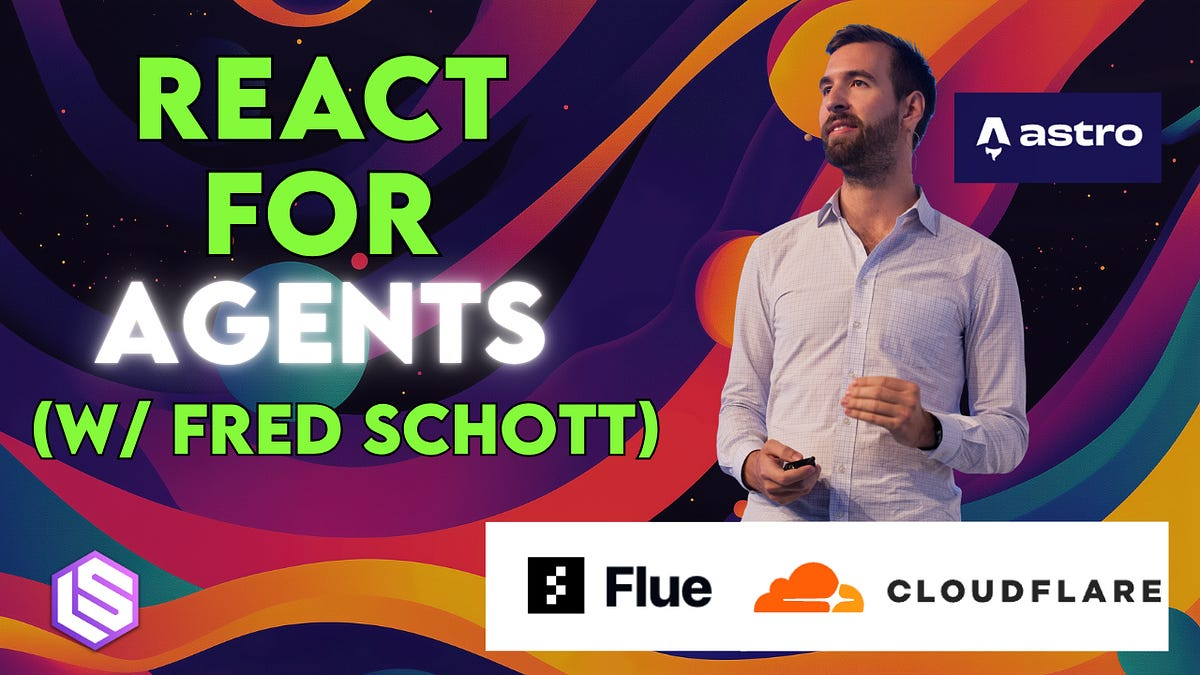
Flue 2 Brings React-Style Hooks to Agent Frameworks
Fred Schott, creator of Astro, has released Flue 2, the first stable version of his agent framework, introducing React-style Agent Hooks. The framework now includes 16 built-in hooks such as useSkill(), useTool(), and useSubagent(), enabling agents to manage their own state and adapt dynamically during interactions. Schott argues that agents are defined by their harness, and Flue is built on Pi, an open-source minimal harness. This shift toward composable, stateful agent architecture borrows from mature web frameworks, potentially lowering the barrier for complex multi-agent systems. However, the field is still nascent; as Bret Taylor noted, we are in the 'jQuery era' of agents, not the React era. The release marks a step forward but also highlights how early we are in agent framework development.
Flue 2 Brings React-Style Hooks to Agent Frameworks
Fred Schott released Flue 2, its first stable release with React-style Agent Hooks. It includes 16 built-in hooks such as useSkill(), useTool(), and useSubagent().
Key takeaway
Agent frameworks are maturing by borrowing composability patterns from React, shifting from static configuration to dynamic, stateful agents built on harnesses.
What happened
Fred Schott, the creator of Astro, released Flue 2, its first stable release, which introduces React-style 'Agent Hooks'. The framework now includes 16 built-in hooks such as useSkill(), useTool(), and useSubagent(), allowing agents to manage their own state and dynamically attach capabilities at runtime.
Schott, whose company was acquired by Cloudflare in January, explained that agents are defined by their harness. Flue is built on Pi, an open-source minimal harness, and he stated, 'There is no agent without a harness.' The shift came after early users revealed that many companies treat their entire organization as one agent, necessitating composability over routing.
Evidence
Flue 2 includes 16 built-in hooks such as useSkill(), useTool(), and useSubagent().
Latent Space · attributed
There are 16 built-in hooks in Flue 2, including useSkill(), useTool(), useSubagent().
Schott states that 'There is no agent without a harness.'
Latent Space · attributed
"There is no agent without a harness."
Why it matters
The adoption of hooks and harness-centric design could democratize complex agent development, but it also signals that the industry is still finding its footing, with foundational patterns yet to be standardized.
Limits and uncertainties
The report is based on a single source (Latent Space) and may reflect the author's interpretation.
There is a discrepancy in the packet: the related article analysis refers to 'Michael Schott' while the main body and article refer to 'Fred Schott', indicating a possible typo.
Practical implications
Builders should experiment with hooks to create adaptive agents, but also understand that the harness is a core architectural component. This pattern may influence other agent frameworks.
What to watch
Monitor adoption of Flue 2 and whether other frameworks like Vercel's eve incorporate similar hook-based design.
Watch for further commentary on the 'React era' of agents and how the harness concept evolves.