Epoch AI: AI chip price-performance grows 49% per year
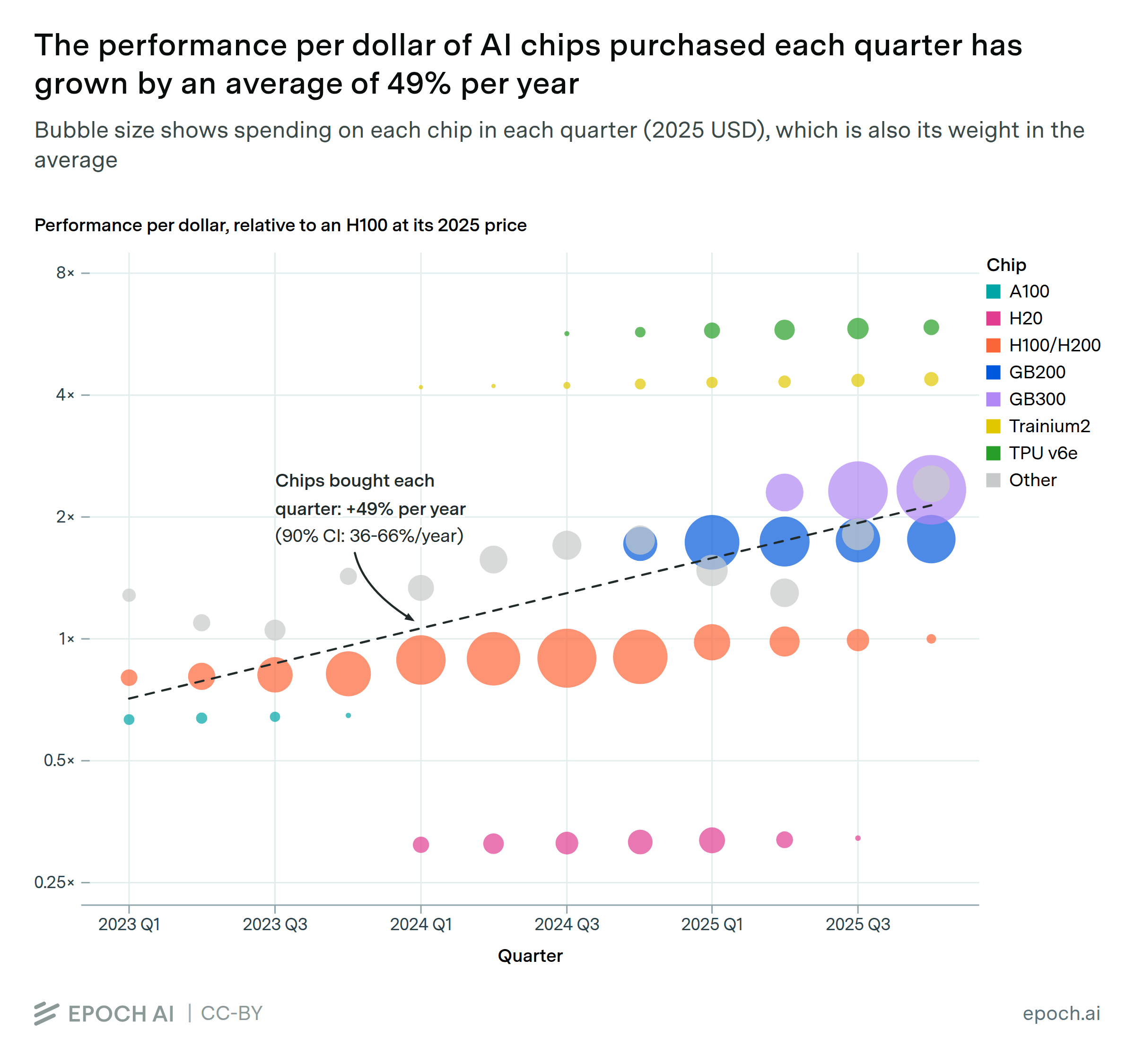
Epoch AI's analysis of quarterly AI chip sales shows that the performance per dollar of purchased chips has grown at an average of 49% per year since 2023, implying a dollar buys twice the compute every 1.7 years in constant 2025 dollars. The improvement was uneven: nearly flat through mid-2024, then roughly doubled as Blackwell-generation chips became the majority of new spending. Concrete figures show performance per dollar rising from about 5.6e11 to 1.4e12 bit-operations per second per dollar between Q1 2023 and end of 2025. This rapid deflation in compute costs could substantially lower the cost of training and running AI models, enabling larger or more frequent deployments. A key caveat: the analysis models chips sold, not deployed, and uses representative purchase prices that may not capture later price cuts.
Epoch AI: AI chip price-performance grows 49% per year
Epoch AI reports the performance per dollar of AI chips purchased each quarter has grown by an average of 49% per year. Since 2023, the average dollar spent on AI chips each quarter has yielded about 49% more performance each year in constant 2025 dollars, doubling every 1.7 years as spending shifts to each new chip generation.
Key takeaway
AI compute price-performance improves at ~49% annually, halving the cost of a given workload every ~1.7 years, driven by generational chip leaps.
What happened
Epoch AI reported on August 13, 2026, that the performance per dollar of AI chips purchased each quarter has grown by an average of 49% per year since 2023, based on data from their AI Chip Sales Hub. The analysis computes the combined computing performance of chips sold divided by total spending in constant 2025 dollars, rising from about 5.6e11 bit-operations per second per dollar in Q1 2023 to approximately 1.4e12 by the end of 2025.
The growth was not steady: price-performance was nearly flat through mid-2024, then roughly doubled as Blackwell-generation chips grew to a majority of new spending. Epoch also notes that NVIDIA's GB300 costs about 5.5 times the P100's 2016 launch price but delivers roughly 200 times the performance, making it about 37 times more cost effective. Most AI hardware spending currently goes to Nvidia GPUs, which command higher margins and thus have lower performance-per-dollar than some custom ASICs.
Evidence
Since 2023, the average dollar spent on AI chips each quarter has yielded about 49% more performance each year.
Epoch AI · attributed
Since 2023, the average dollar spent on AI chips each quarter has yielded about 49% more performance each year.
The performance a dollar buys doubles every 1.7 years.
Epoch AI · attributed
At that rate, the performance a dollar buys doubles every 1.7 years.
Performance per dollar rose from about 5.6e11 bit-operations per second per dollar in Q1 2023 to about 1.4e12 by the end of 2025.
Epoch AI · attributed
Performance per dollar rose from about 5.6 × 10^11 bit-operations per second per dollar in the first quarter of 2023 to about 1.4 × 10^12 by the end of 2025, in constant 2025 dollars.
The improvement was uneven, with price-performance nearly flat through mid-2024, then roughly doubling as Blackwell-generation chips became a majority of new spending.
Epoch AI · attributed
Price-performance was nearly flat through mid-2024, then roughly doubled as Blackwell-generation chips grew to a majority of new spending.
Why it matters
This rapid improvement in compute price-performance could substantially lower the cost of training and running AI models, enabling larger or more frequent deployments and potentially accelerating AI adoption across industries.
Limits and uncertainties
The analysis covers only through Q4 2025 because sales estimates for later quarters are incomplete.
It models units sold rather than deployed.
It uses representative purchase prices and does not capture later price cuts or spot prices.
Some chips like the H100/H200 have year-specific prices, while others assume a single constant price across all quarters.
Practical implications
Builders and operators can expect inference costs to drop precipitously, enabling real-time, high-volume AI applications to become economically viable.
The shifting competitive advantage from owning hardware to optimizing software efficiency suggests investing in algorithm and architecture optimization.
Given that most spending goes to Nvidia GPUs with lower performance-per-dollar than ASICs, exploring custom accelerators could offer cost benefits.
What to watch
Whether the 49% annual growth rate continues or accelerates with future chip generations.
Adoption of custom ASICs like Google TPU v6e, which offer higher performance per dollar than mainstream GPUs.
Any changes in Nvidia's pricing strategy that could affect the aggregate performance-per-dollar trend.