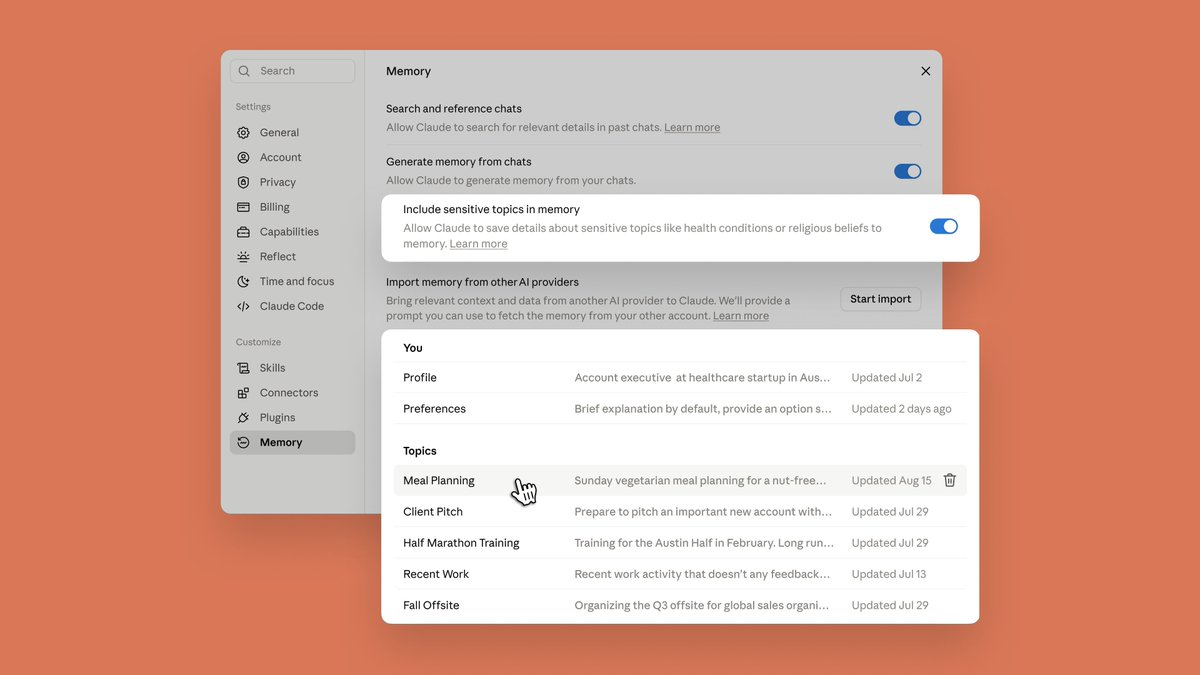
Anthropic says Claude now runs on one shared memory across standard chat and Claude Cowork, letting agent tasks inherit context from prior conversations instead of starting cold. Users choose what gets stored, and Cowork can draw on chat history such as active projects, manager preferences, or clients discussed earlier. Companion details in the available material also describe memory controls: a Settings toggle for sensitive topics, categorized memory topics, and a dedicated Memory tab inside Claude. For builders and operators, the shift links lightweight chat with longer Cowork workflows, but the packet does not spell out rollout scope, default retention behavior, or how cross-surface recall is enforced in production.
Anthropic says Claude now has one memory across chat and Claude Cowork, and users decide what is stored. Hand Cowork a task and it starts from what Claude already knows from your chats, including projects, manager preferences, or prior clients.
Key takeaway
Unified chat-and-Cowork memory turns prior conversations into reusable task context, with user-controlled storage settings.
What happened
Anthropic announced on its official X channel that Claude now maintains one memory across chat and Claude Cowork, and that users decide what is stored in that shared layer.
The company said handing Cowork a task lets it start from what Claude already knows from chats, including projects, manager preferences, or prior clients. Packet snippets also cite a Settings toggle for sensitive topics, categorized memory topics, and a dedicated Memory tab in Claude.
Evidence
Claude has one memory across chat and Claude Cowork, with user control over what is stored.
X · attributed
Anthropic says Claude now has one memory across chat and Claude Cowork, and users decide what is stored.
Cowork tasks can start from prior chat knowledge such as projects, manager preferences, or earlier clients.
X · attributed
Hand Cowork a task and it starts from what Claude already knows from your chats, including projects, manager preferences, or prior clients.
Memory management adds a sensitive-topics toggle, categorized topics, and a dedicated Memory tab.
X · attributed
a new toggle to keep memories about sensitive topics has been added to the Settings menu.
Why it matters
The update blurs the line between quick chats and multi-step Cowork runs, raising governance needs around what persists across surfaces.
Limits and uncertainties
The packet does not specify rollout timing, regions, or which plans receive unified memory.
Default retention behavior and how aggressively Cowork reuses chat context are not documented in the primary source.
Practical implications
Teams using Cowork should review Memory settings and the sensitive-topics toggle before relying on chat context in agent tasks.
Operators should inventory what Claude may retain across chat and Cowork for workplace, client, or compliance reviews.
What to watch
Whether Anthropic publishes detailed memory retention, deletion, and cross-surface sync controls beyond the user-facing toggle.
How Cowork output quality and error rates change when tasks draw on prior chat context about managers or clients.
Original reporting: Claude now has one memory across chat and Claude Cowork, and you decide what's in it.
Hand Cowork a task and it starts from what Claude already knows from your chats: the project