Anthropic unifies Claude memory across Chat and Cowork
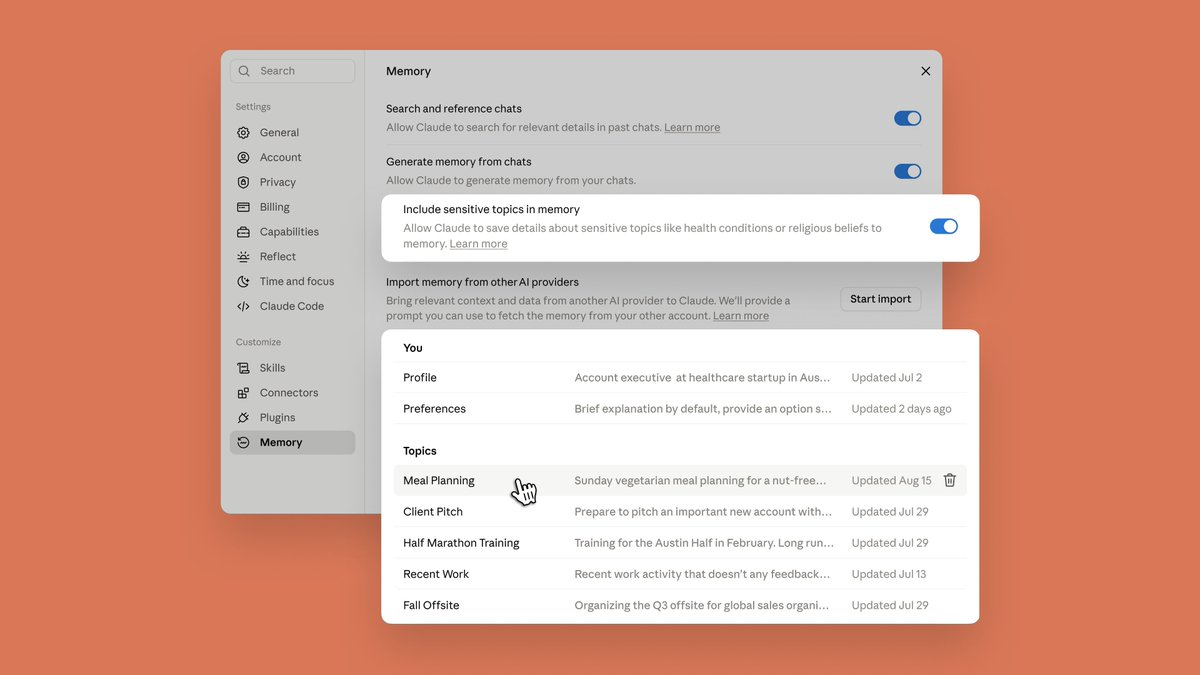
Anthropic announced that Claude now uses one shared memory store across Claude Chat and Claude Cowork, letting users control what Claude retains. According to Anthropic's post on X, when Cowork receives a task it can start from context Claude already picked up in chat, such as a project discussed earlier, a manager's preferences, or a client from a prior quarter. Secondary signals in the packet also describe Settings controls, including a toggle for memories about sensitive topics, splitting memories into separate categories, and a dedicated Memory tab in Claude. For builders and operators, the change matters because chat and agent workflows no longer rely on manually reintroducing the same context. Anthropic frames retention as user-directed, but the packet does not spell out rollout timing, enterprise boundaries, or how memory sync behaves across accounts or workspaces.
Anthropic unifies Claude memory across Chat and Cowork
Claude now has one memory across chat and Claude Cowork, and you decide what's in it. Hand Cowork a task and it starts from what Claude already knows from your chats: the project you talked through, your manager's preferences, or the client from last quarter.
Key takeaway
Claude Chat and Cowork now share a unified memory store, so Cowork tasks can inherit prior chat context without manual re-briefing.
What happened
Anthropic announced on X that Claude now maintains one shared memory across Claude Chat and Claude Cowork, and users decide what Claude retains in that memory.
Anthropic said Cowork tasks can start from chat context such as projects discussed earlier, manager preferences, or clients from prior quarters; supplemental packet text also notes Settings controls for sensitive-topic memories, separate memory categories, and a dedicated Memory tab.
Evidence
Claude uses one shared memory across Chat and Cowork with user control over retention.
X · attributed
Claude now has one memory across chat and Claude Cowork, and you decide what's in it.
Cowork tasks can start from context Claude already knows from prior chats.
X · attributed
Hand Cowork a task and it starts from what Claude already knows from your chats: the project you talked through, your manager's preferences, or the client from last quarter.
Settings include a new toggle for memories about sensitive topics.
X · attributed
Also, a new toggle to keep memories about sensitive topics has been added to the Settings menu.
Memories are split into separate categories.
X · attributed
Memoriesed topics are now split into separate categories.
Memory has a dedicated tab in Claude.
X · attributed
Memory now has a dedicated tab in Claude
Why it matters
Work routed between conversational chat and Cowork agents can reuse stored project history, preferences, and client details instead of repeating that context on every handoff.
Limits and uncertainties
The packet does not specify rollout timing, geographic availability, or enterprise or workspace boundaries for unified memory.
Settings details about sensitive-topic toggles, category splits, and the Memory tab appear in secondary packet text rather than the primary X post body.
The secondary snippet uses the typo 'Memoriesed topics,' leaving the exact category labeling unclear.
Practical implications
Test Cowork workflows assuming prior chat context may be available automatically at task start.
Review Claude Memory settings, including sensitive-topic controls and categories, before storing manager or client details.
Update internal runbooks so teams know chat and Cowork now share one memory surface.
What to watch
Whether enterprise and workspace accounts receive the same unified memory behavior described for Chat and Cowork.
How memory deletion, category controls, and the sensitive-topic toggle behave in production settings.
Follow-on Anthropic documentation or posts beyond this X announcement.
Original reporting: Claude now has one memory across chat and Claude Cowork, and you decide what's in it.
Hand Cowork a task and it starts from what Claude already knows from your chats: the project