Anthropic Opens Research Preview of Model Hardware Standard for AI Agent Device Control
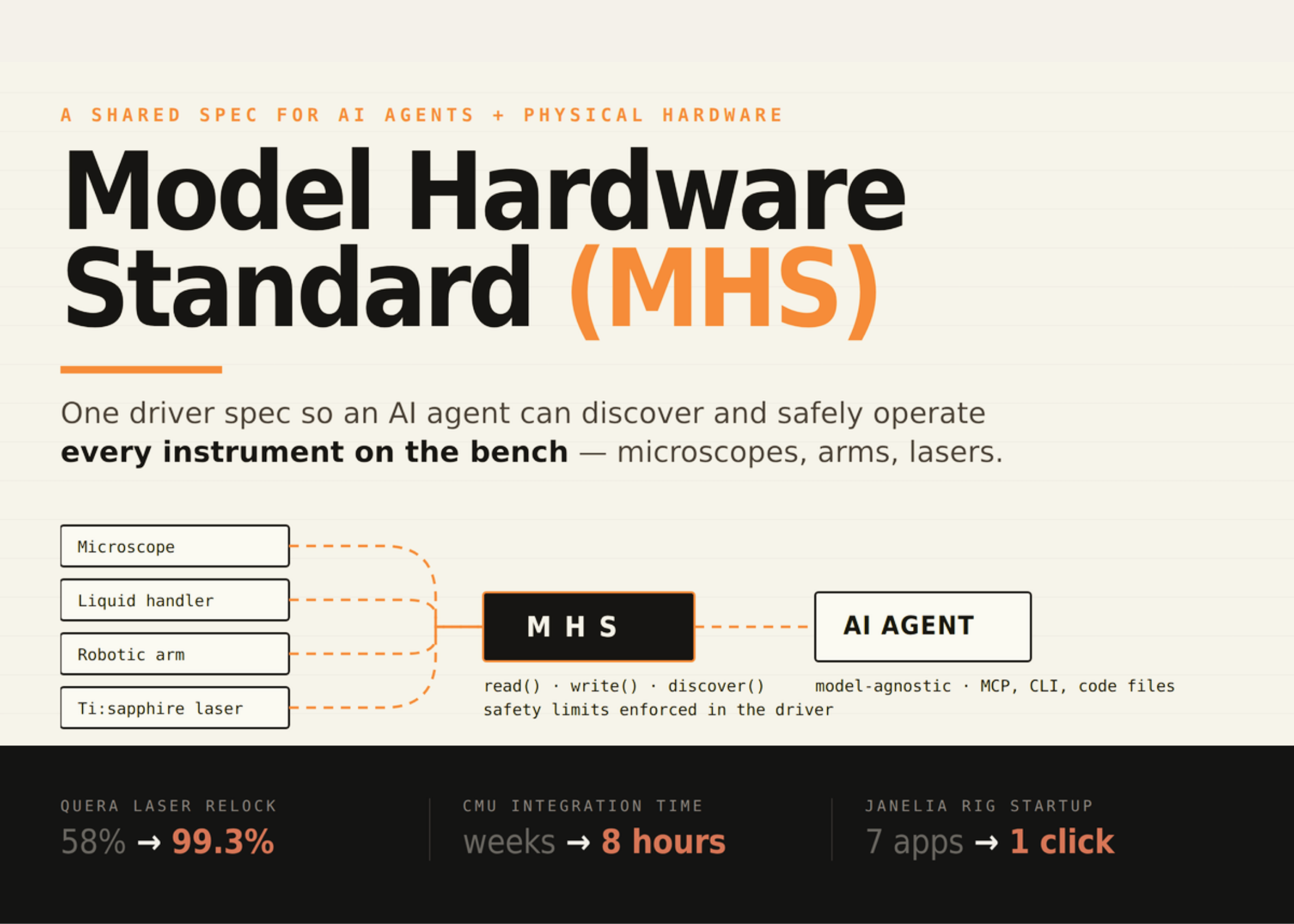
Anthropic has released a research preview of the Model Hardware Standard (MHS), a shared driver specification designed to let AI agents discover and safely operate physical devices ranging from laboratory instruments to robotic arms. Early adopters report dramatic compression of integration timelines: MarkTechPost cites Carnegie Mellon moving from raw equipment to a finished dose-response curve in eight hours, while The Decoder notes integrations that formerly required weeks now complete in hours. The effort mirrors Anthropic's earlier Model Context Protocol strategy, extending standardized agent interfaces from software into hardware control. However, early testing exposed limits—Claude models sometimes struggled with physical cause and effect, and reporters emphasize that human oversight remains necessary during this research phase. Laboratories, robotics vendors, and agent builders should treat MHS as an acceleration layer rather than a fully autonomous operations stack.
Anthropic Opens Research Preview of Model Hardware Standard for AI Agent Device Control
Anthropic has opened a research preview of the Model Hardware Standard (MHS), a shared driver specification that lets AI agents discover and safely operate physical devices. Instrument integration that normally takes weeks or months drops to hours.
Key takeaway
MHS gives labs and robotics teams a standardized hardware driver layer that can shrink multi-week instrument integrations to hours, but early reliability gaps mean human supervision stays mandatory for now.
What happened
Anthropic has opened a research preview of the Model Hardware Standard (MHS), a shared driver specification that lets AI agents discover and safely operate physical devices, according to MarkTechPost and CNBC reporting on the launch.
The Decoder reports MHS provides a unified interface to devices such as robotic arms and lab instruments, with early tests showing integration timelines falling from weeks to hours; MarkTechPost cites Carnegie Mellon reaching a finished dose-response curve from raw equipment in eight hours.
Evidence
Anthropic opened a research preview of MHS as a shared driver specification for AI agents to discover and safely operate physical devices.
MarkTechPost · attributed
Anthropic has opened a research preview of the Model Hardware Standard (MHS), a shared driver specification that lets AI agents discover and safely operate physical devices.
Instrument integration timelines that normally take weeks or months can drop to hours under MHS.
MarkTechPost · attributed
Instrument integration that normally takes weeks or months drops to hours.
Carnegie Mellon reportedly went from raw equipment to a finished dose-response curve in eight hours.
MarkTechPost · attributed
Carnegie Mellon went from raw equipment to a finished dose-response curve in eight
MHS gives AI agents a unified interface to physical devices like robotic arms and lab instruments.
The Decoder · attributed
Anthropic's Model Hardware Standard (MHS) gives AI agents a unified interface to physical devices like robotic arms and lab instruments.
Claude sometimes failed to grasp physical cause and effect in early tests, so human oversight remains essential.
The Decoder · attributed
But Claude sometimes failed to grasp physical cause and effect, so human oversight remains essential for now.
Anthropic is pushing a new standard to help AI agents operate machines in the physical world.
CNBC AI · attributed
Anthropic pushes into physical world with new standard to help AI agents operate machines
Why it matters
Anthropic is attempting to replicate the Model Context Protocol's software interoperability playbook for physical hardware, which could shift how agent platforms compete beyond APIs and text interfaces.
Limits and uncertainties
Claude sometimes failed to grasp physical cause and effect in early tests, so human oversight remains essential according to The Decoder.
The launch is a research preview, not a guarantee of production-ready autonomous device operation.
MarkTechPost's QuEra laser example is truncated in available excerpts, limiting verification of that specific case.
Practical implications
Teams building agent workflows for lab automation should evaluate MHS drivers before writing bespoke instrument integration code.
Operators deploying Claude on physical hardware should plan human-in-the-loop checkpoints until physical reasoning reliability improves.
What to watch
Whether additional hardware vendors publish MHS-compatible drivers beyond early lab and robotics partners cited in coverage.
How Anthropic addresses physical cause-and-effect failures reported during early Claude-driven hardware tests.
Whether integration timelines reported in hours hold outside initial pilot environments.
Original reporting: Anthropic Opens a Research Preview of the Model Hardware Standard (MHS): A Shared Specification for AI Agents to Safely Operate Physical Devices