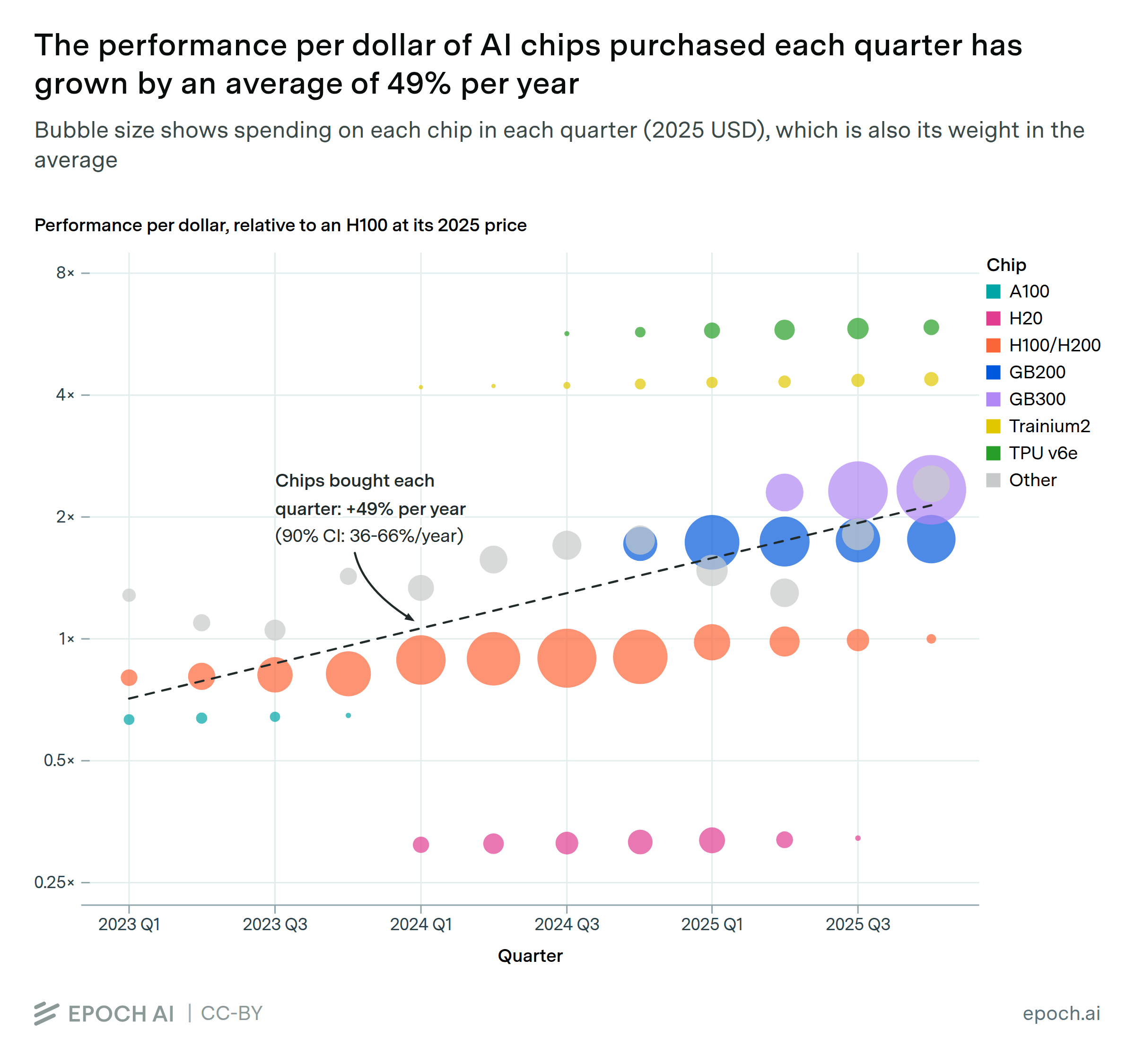
AI chip performance per dollar grows 49% per year, doubling every 1.7 years
Since 2023, the average dollar spent on AI chips each quarter has bought ~49% more performance each year, so performance per dollar doubles every 1.7 years. Growth was uneven: flat through mid-2024, then roughly doubled as Nvidia's Blackwell became dominant. By Q4 2025, average performance per dollar hit ~1.4e12 bit-operations/s/$, up from 5.6e11 in Q1 2023. New chip generations drive gains; Nvidia's GB300 costs 5.5x the 2016 P100 but delivers ~200x performance, a 37x cost-effectiveness improvement. The average is dragged down by Nvidia GPUs' high margins, while custom ASICs like Google's TPU v6e are more efficient. Caveats: data spans 2023–Q4 2025 and tracks chips sold, not deployed.
AI chip performance per dollar grows 49% per year, doubling every 1.7 years
Since 2023, the average dollar spent on AI chips each quarter has yielded about 49% more performance each year. At that rate, the performance a dollar buys doubles every 1.7 years.
Key takeaway
AI compute price-performance improves at ~49% annually, halving the cost of a given workload every ~1.7 years, driven by generational chip leaps.
What happened
Epoch AI's analysis of quarterly AI chip sales shows that since 2023, the aggregate performance per dollar of purchased chips has grown at an average rate of 49% per year, implying a doubling every 1.7 years in constant 2025 dollars.
The improvement was uneven: performance per dollar was nearly flat through mid-2024, then roughly doubled as Nvidia's Blackwell-generation chips became a majority of new spending. By Q4 2025, the average reached about 1.4e12 bit-operations per second per dollar, up from 5.6e11 in Q1 2023. Chip generations like GB300 deliver roughly 200x the performance of a 2016 P100 at 5.5x the cost, a 37x cost-effectiveness gain.
Evidence
The performance per dollar of AI chips purchased each quarter has grown by an average of 49% per year since 2023.
Epoch · attributed
Since 2023, the average dollar spent on AI chips each quarter has yielded about 49% more performance each year.
Performance per dollar doubles every 1.7 years on average.
Epoch · attributed
At that rate, the performance a dollar buys doubles every 1.7 years.
Growth was flat through mid-2024, then roughly doubled as Blackwell-generation chips became a majority of new spending.
Epoch · attributed
Price-performance was nearly flat through mid-2024, then roughly doubled as Blackwell-generation chips grew to a majority of new spending.
Average performance per dollar rose from 5.6e11 to 1.4e12 bit-operations per second per dollar from Q1 2023 to end-2025.
Epoch · attributed
Performance per dollar rose from about 5.6 × 10^11 bit-operations per second per dollar in the first quarter of 2023 to about 1.4 × 10^12 by the end of 2025, in constant 2025 dollars.
Nvidia's GB300 is about 37 times more cost-effective than the 2016 P100.
Epoch · attributed
In 2025 dollars, NVIDIA’s GB300 costs about 5.5 times the P100’s 2016 launch price, yet it delivers roughly 200 times the performance, making it about 37 times more cost effective.
Most AI hardware spending goes to Nvidia GPUs, which have lower price-performance than some custom ASICs.
Epoch · attributed
Most AI hardware spending currently goes towards Nvidia’s GPUs, which command a relatively high margin and thus have a lower price-perf than some custom ASICs.
Why it matters
This rapid improvement in compute price-performance could substantially lower the cost of training and running AI models, enabling larger or more frequent deployments and potentially accelerating AI adoption across industries, while reshaping competitive dynamics among chipmakers and cloud providers.
Limits and uncertainties
The series begins in 2023 because coverage before then is sparse, and ends in Q4 2025 because sales estimates for later quarters are not yet complete.
The analysis models chips sold, not deployed, and uses representative purchase prices (not rental) that may miss later price cuts or spot prices.
The average is skewed by Nvidia's high-margin GPUs dominating spending, even though custom ASICs like Google's TPU v6e offer higher performance per dollar.
Practical implications
When budgeting for AI compute, expect ~49% annual improvement in price-performance, so costs for a fixed workload fall by half roughly every 1.7 years.
Consider evaluating custom ASICs like Google's TPU v6e for better efficiency, but be aware that Nvidia's dominance may affect average figures.
Use these trends to inform long-term capacity planning and procurement decisions for AI hardware.
What to watch
Future Epoch AI chip sales data updates to see if the ~49% annual growth rate continues as new generations such as Nvidia's Rubin or successor architectures are introduced, and whether price-performance improvement accelerates or decelerates.